
Request the Monuments Database
The weekly “Monday’s Monument” feature on this website is being fed from a database we are compiling that currently contains 200+ monuments. If you’d like a copy of the database, drop us a line.
Peace & Justice Monuments
Since May, 2015, every Monday morning the peaceCENTER has been posting a little essay about a peace or social justice monument. For more than a decade, ever since the peaceCENTER was contracted by a national peace & human rights group to develop a workshop exploring strategies for creating memorials about acts of violence and injustice that did not glorify the bloodshed, we have pondered the relationship between the landscape and civic memory.
“I would rather take care of the stomachs of the living than the glory of the departed in the form of monuments.”
Alfred Nobel
As we showcase these monuments we hope you will join us in this exploration. For now, we’re concentrating on publicly accessible outdoor works (indoor art, museums and historic sites may come later . . . ) Some are grassroots and homespun; others, more complicated in their funding and execution. They all have a story to tell and we can learn from all of them.
MONDAY’S MONUMENT
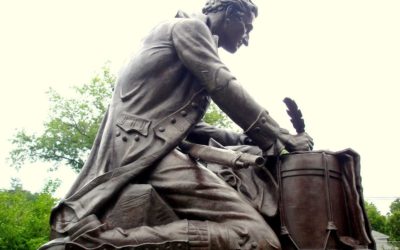
Monday’s Monument: Thomas Paine Statues, US, England and France
Thomas Paine, philosopher of the American and French Revolutions, author of “Common Sense,” has been a controversial figure when it comes to monuments. In 1942 a Paine statue was proposed for Fairmount Park in Philadelphia but the idea was shot down because his book...
read more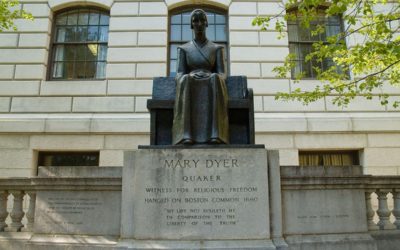
Monday’s Monument: Mary Dyer Statue, Boston, Massachusetts
A Quaker at a time when Quakers were banned from Massachusetts, Dyer eventually hanged for her insistence on religious liberty in the English colony. The statue by Sylvia Shaw Judson went up in 1959 at a descendant's bequest. It's diagonally across from the Boston...
read more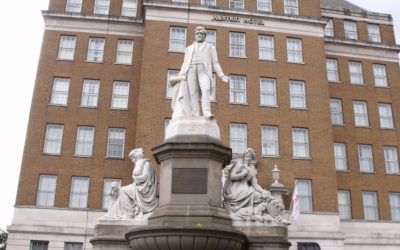
Monday’s Monument: Joseph Sturge Memorial, Birmingham, England
A memorial to the English Quaker, abolitionist and activist Joseph Sturge (1793–1859) was unveiled before a crowd of 12,000 people on 4 June 1862 at Five Ways, Birmingham, England, near his former home. Sturge is posed as if he were teaching, with his right hand...
read more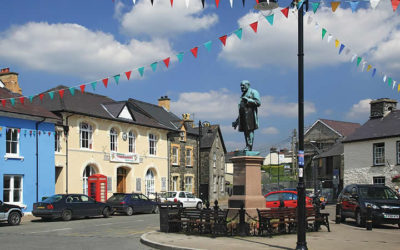
Monday’s Monument: Henry Richard Apostle of Peace Statue, Tregoron, Wales
Henry Richard is chiefly known as an advocate of peace and international arbitration, having been secretary of the Peace Society for forty years (1848–84). He is less widely known for his other interests, especially his anti-slavery work. The statue was dedicated in...
read more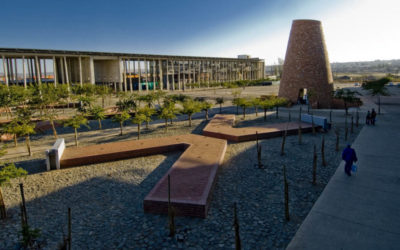
Monday’s Monument, Freedom Charter Monument, Kliptown, Soweto, South Africa
On 26 June 1955, more than 3 000 representatives of resistance organizations made their way through police cordons to gather on a dusty square in Kliptown, 40 kilometers south of Johannesburg. This “Congress of the People” met to draw up the Freedom Charter, an...
read more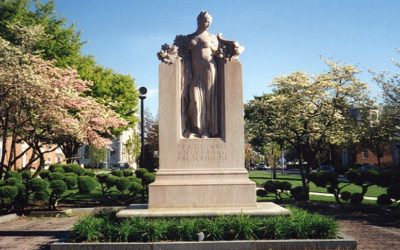
Monday’s Monument: Elihu Burritt Memorial, New Britain, Connecticut
Elihu Burritt was known as the "Learned Blacksmith." He lectured throughout New England about the joy of learning, then turned his attention to humanitarian causes for which he is famous: the abolition of slavery, the dignity of the American working man, and the cause...
read more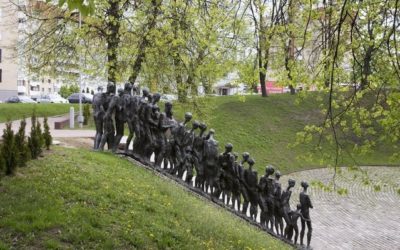
Monday’s Monument: The Pit, Minsk, Belarus
The Pit (Belarusian: Яма) is a monument devoted to the victims of the Holocaust. It is on the site where, on March 2, 1942, the Nazi forces shot about 5,000 prisoners of the nearby Minsk Ghetto. The small polished black granite obelisk was created in 1947 and in 2000...
read more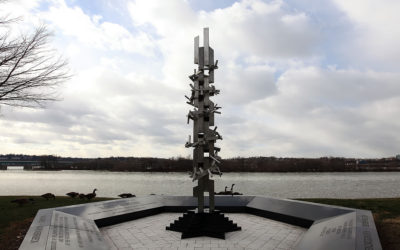
Monday’s Monument: Holocaust Memorial, Harrisburg, Pennsylvania
The monument was dedicated on July 17, 1994, in remembrance of the killing of millions of Jews by the Nazis during World War II. It is set upon a base of six black granite Stars of David which represent the six million Jews who perished during the Holocaust. A central...
read more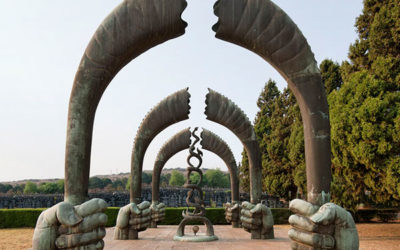
Monday’s Monument: Memorial to the Six Million, Johannesburg, South Africa
Memorial to the Six Million in Johannesburg’s Westpark Cemetery pays tribute to the Jewish men, women and children who lost their lives during the Second World War. The monument depicts six bronze fists, each five feet high, bursting out of the ground as a protest...
read more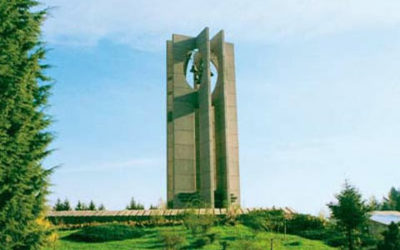
Monday’s Monument: Bells Monument, Sofia, Bulgaria
The Bells Monument (or, in Bulgarian, “Камбаните”) is in a park at the base of the Vitosha mountain. An inscription at the monument’s base reads, “Children of the future accept the eternal, fiery call of immortality - Unity, Creativity, Beauty.” When the UN declared...
read more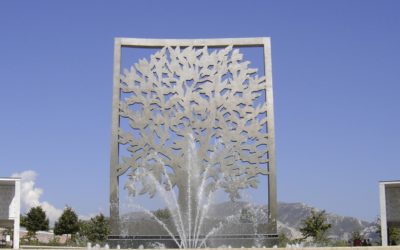
Monday’s Monument: Tree of Hope, Marseille, France
L’arbre de l’espérance sculpture stands at the main entrance to the 26th centennial park in Marseille and was unveiled in 2000 as part of the 2,600 anniversary of the foundation of the city. 350,000 people of all faiths and none, native to Marseille or immigrants...
read more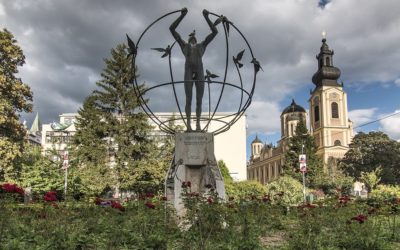
Monday’s Monument: Multicultural Man Builds the World, Sarajevo, Bosnia and Herzegovina
The sculpture sits on Trg Oslobođenje – Libertion Square – in the center of Sarajevo. It consists of a naked male figure reaching toward the sky, pulling the meridians of the earth together. Around him, doves help by lifting further meridians into place. The...
read more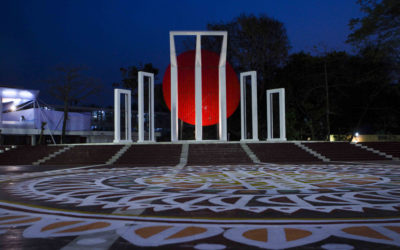
Shaheed Minar (Language Martyrs Monument), Dhaka, Bangladesh
The Shaheed Minar (Bengali: শহীদ মিনার Shohid Minar lit. "Martyr Monument") commemorates those killed during the Bengali Language Movement demonstrations of 1952 in then East Pakistan. On 21 and 22 February 1952, students from Dhaka University and Dhaka Medical...
read more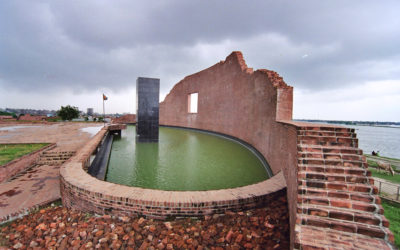
Monday’s Monument: Martyred Intellectuals Memorial, Dhaka, Bangladesh
The Martyred Intellectuals Memorial (Bengali: বুদ্ধিজীবি স্মৃতি সৌধ) was built in memory of the martyred intellectuals of the Bangladesh Liberation War. The cornerstone was laid in 1991. On the night of 14 December 1971, over 200 of East Pakistan's intellectuals...
read more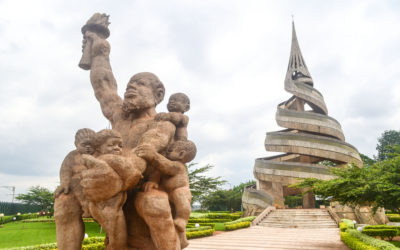
Monday’s Monument: Reunification Monument, Yaoundé, Cameroon
After WW I and the signing of the Treaty of Versailles, Cameroon, a German protectorate, was divided into two regions and put under French and British rule. In January 1960, French Cameroon became independent, British Cameroon, 10 months later. In 1972 the two...
read more
If you
haven’t read
this book,
you should!
Ten Questions to Ask at a Historic Site
In his book Lies Across America, Professor James Loewen posed these ten questions to ask at a historic site.
1. When did this location become a historic site? (When was the marker or monument put up? Or the house interpreted?) How did that time differ from ours? From the time of the event or person interpreted?
2. Who sponsored it? representing which participant groups’s point of view? What was their position in the social structure when the event occurred? When the site went “up”?
3. What were the sponsor’s motives? What were their ideological needs and social purposes? What were their values?
4. What is the intended audience for the site? What values were they trying to leave for us, today? What does the site ask us to go and do or think about?
5. Did the sponsors have government support? At what level? Who was ruling the government at the time? What ideological arguments were used to get the government acquiescence?
6. Who is left out? What points of view go largely unheard? How would the story differ if a different group told it? Another political party? Race? Sex? Class? Religious group?
7. Are there problematic (insulting, degrading) words or symbols that would not be used today, or by other groups?
8. How is the site used today? Do traditional rituals continue to connect today’s public to it? Or is it ignored? Why?
9. Is the presentation accurate? What actually happened? What historical sources tell of the event, people, or period commemorated at this site?
10. How does the site fit in with others that treat the same era? Or subject? What other people lived ad events happened then but are not commemorated? Why?
Travel across the United States in a 1965 Airstream Trailer as filmmaker Tom Trinley visits historic sites and monuments unveiling the many sides of history not told on the landscape or in history books. On-camera appearances by Howard Zinn, James Loewen, Lonnie Bunch and Adam “Fortunate Eagle” Nordwall. Inspired by “Lies My Teacher Told Me” and “A Peoples’ History of the United States.”
At the Un-National Monument along the Canadian Border
By William E. Stafford
This is the field where the battle did not happen,
where the unknown soldier did not die.
This is the field where grass joined hands,
where no monument stands,
and the only heroic thing is the sky.
Birds fly here without any sound,
unfolding their wings across the open.
No people killed—or were killed—on this ground
hallowed by neglect and an air so tame
that people celebrate it by forgetting its name.
Of princes, shall outlive this powerful rhyme;
But you shall shine more bright in these contents
Than unswept stone besmear’d with sluttish time.
When wasteful war shall statues overturn,
And broils root out the work of masonry,
Nor Mars his sword nor war’s quick fire shall burn
The living record of your memory.
–William Shakespeare, from Sonnet 55

Listen to this song!
And we find it really hard to say we’re sorry
So the shadow of injustice still remains
We build monuments to those who died in battle
But we seldom speak of those who died in chains