
Request the Monuments Database
The weekly “Monday’s Monument” feature on this website is being fed from a database we are compiling that currently contains 200+ monuments. If you’d like a copy of the database, drop us a line.
Peace & Justice Monuments
Since May, 2015, every Monday morning the peaceCENTER has been posting a little essay about a peace or social justice monument. For more than a decade, ever since the peaceCENTER was contracted by a national peace & human rights group to develop a workshop exploring strategies for creating memorials about acts of violence and injustice that did not glorify the bloodshed, we have pondered the relationship between the landscape and civic memory.
“I would rather take care of the stomachs of the living than the glory of the departed in the form of monuments.”
Alfred Nobel
As we showcase these monuments we hope you will join us in this exploration. For now, we’re concentrating on publicly accessible outdoor works (indoor art, museums and historic sites may come later . . . ) Some are grassroots and homespun; others, more complicated in their funding and execution. They all have a story to tell and we can learn from all of them.
MONDAY’S MONUMENT
Monday’s Monument: World Peace Prayer Fountain, Fayetteville, Arkansas
The World Peace Prayer fountain sculpture, designed by Hank Kaminsky, was dedicated on New Years Eve 2002. It is a 10' diameter bronze sphere sculpted in a traditional way with the prayer "May Peace Prevail on Earth" in over 100 languages hand sculpted on the surface....
read more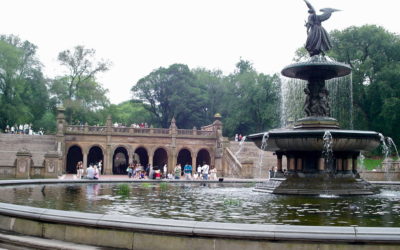
Monday’s Monument: Bethesda Fountain, Central Park, New York, New York
This neoclassical sculpture, also known as Angel of the Waters, features an eight-foot bronze angel who stands above four small cherubim representing health, purity, temperance, and peace. The angel herself carries a lily in one hand while the other remains...
read more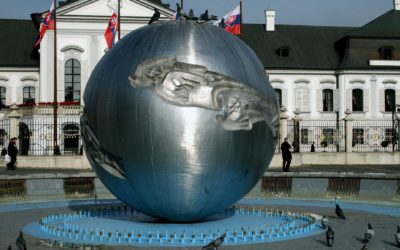
Monday’s Monument: Earth – Planet of Peace, Bratislava, Slovakia
A fountain called Earth — Planet of Peace (Zem - planeta mieru) is the centerpiece of Hodžovo Námestie (English: Hodžovo Square, in front of the Grassalkovich Palace. It was sculpted by Tibor Bártfay, Pavel Mikšík, and Karol Lacko and installed in 1982.
read more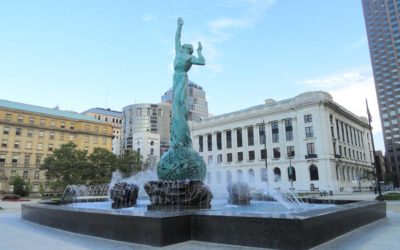
Monday’s Monument: Fountain of Eternal Life, Cleveland, Ohio
The original concept for the memorial was as a memorial for Vietnam Veterans but was changed to one which honored all those who died or were declared missing in wars fought from 1900 until now. The granite base surrounding the fountain now includes 5,558 names of...
read more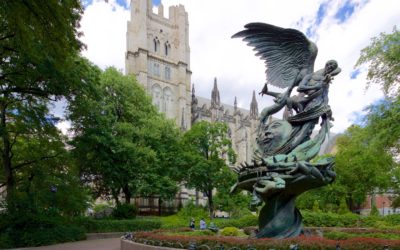
Monday’s Monument: St. John the Divine Peace Fountain, New York, New York
The Peace Fountain was sculpted by the Episcopal Cathedral's Artist-in-Residence Greg Wyatt to mark the 200th anniversary of the Diocese of New York in 1985. The 40 foot-high bronze sculpture weaves together several representations of the conflict between good and...
read more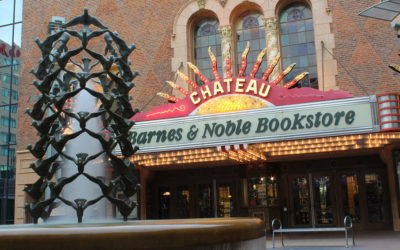
Monday’s Monument: Peace Fountain, Rochester, New York
Located in the middle of the popular Peace Plaza, it stands 12 feet high and is made of a circular tier of 57 life-sized interlocking bronze doves. They symbolize the 50 United States and the 7 major continents of the world. The three doves on top represent past,...
read more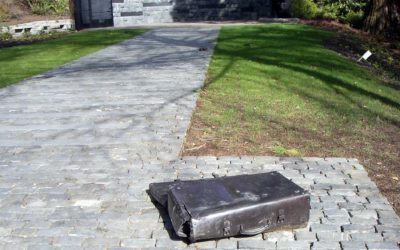
Monday’s Monument: Holocaust Memorial, Portland, Oregon
The memorial features a stone bench with wrought iron gating around a cobblestone circle. Scattered bronzes of common objects such as shoes, glasses, a teddy bear and a suitcase represent items left behind by those persecuted during the Holocaust. A cobblestone...
read more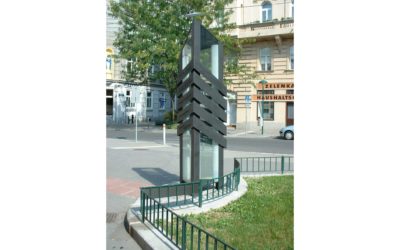
Monday’s Monument: Memorial Column for The Righteous, Vienna, Austria
Located in the Carmelite Quarter, this monument was dedicated in May, 1999. The text reads: "They rendered silent resistance to the the Nazi tyranny. Through personal courage they saved threatened fellow citizens from persecution and death. They put themselves in...
read more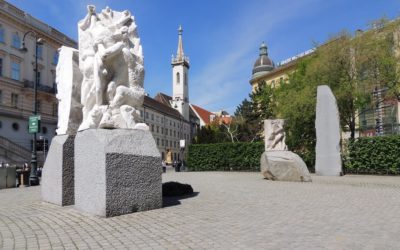
Monday’s Monument: Monument Against War and Fascism, Vienna, Austria
Mahnmal gegen Krieg und Faschismus, a memorial to the civil victims of the Second World War, was unveiled on November 24, 1988. “Tor der Gewalt,” which is generally translated as “Gates of Violence” or “Gates of Power” or sometimes “Gates of War” is the first part of...
read more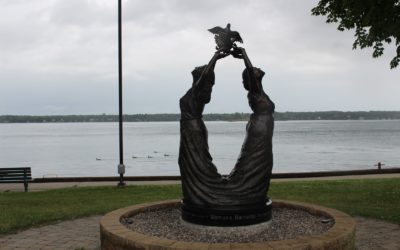
Monday’s Monument: Women’s Memorial, Brockville Ontario, Canada
The Women's Memorial was dedicated on November 18, 2010 at the Brockville Arts Centre during an unveiling ceremony entitled "Voices of Hope," a community celebration to end violence against women. The base of the monument is engraved: "This Memorial is dedicated to...
read more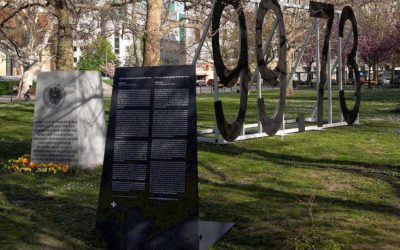
Monday’s Monument: MexikoPlatz, Vienna, Austria
In 1956 Vienna renamed Erzherzog-Karl-Platz (Archduke Karl Square) as MexikoPlatz, and erected this memorial commemorating Mexico's condemnation of the Anschluss (Nazi annexation of Austria to make a “Greater Germany”) in March, of 1938, the only country in the League...
read more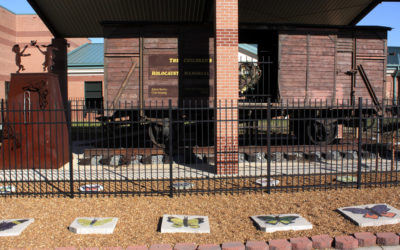
Monday’s Monument: Children’s Holocaust (Paper Clip) Memorial, Whitwell, Tennessee
In 1998 in a Whitwell Middle School History class discussing World War II learned that six million Jews were slaughtered in the Nazi camps. A student asked how big Six Million is; another student read that people from Norway wore paperclips as a symbol of resistance...
read more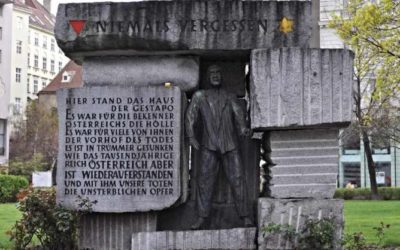
Monday’s Monument: Monument for the Victims of Nazi Despotism, Vienna, Austria
Hotel Metropole at Morzinplatz was used as a headquarter for the Gestapo 1938-1945 and on the Morzinplatz there is now a monument commemorating the Austrian victims made from granite from the Mauthausen concentration camp. The memorial was originally a memorial stone...
read more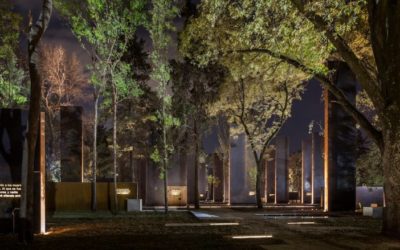
Monday’s Monument: Memorial of the Victims of the Violence in Mexico, Mexico City, Mexico
Dedicated in April, 2003, the memorial, which was designed by Gaeta Springall Arquitectos, is made from 70 pieces of weathered of Corten steel, some raw, some with mirrors on their sides. It occupies nearly four acres of the Chapultepec Forest, land formerly...
read more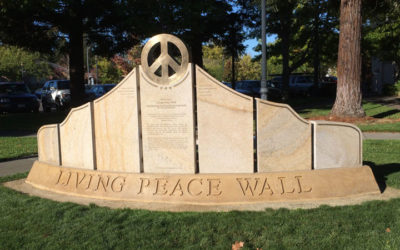
Monday’s Monument: Living Peace Wall, Sebastapol, California
The Living Peace Wall, dedicated in 2015, consists of panels of granite inscribed with the names of advocates for peace, justice and nonviolence. It is crowned with a brass peace sign. The central panel's engraving begins with a quotation from Gandhi: “Nonviolence is...
read more
If you
haven’t read
this book,
you should!
Ten Questions to Ask at a Historic Site
In his book Lies Across America, Professor James Loewen posed these ten questions to ask at a historic site.
1. When did this location become a historic site? (When was the marker or monument put up? Or the house interpreted?) How did that time differ from ours? From the time of the event or person interpreted?
2. Who sponsored it? representing which participant groups’s point of view? What was their position in the social structure when the event occurred? When the site went “up”?
3. What were the sponsor’s motives? What were their ideological needs and social purposes? What were their values?
4. What is the intended audience for the site? What values were they trying to leave for us, today? What does the site ask us to go and do or think about?
5. Did the sponsors have government support? At what level? Who was ruling the government at the time? What ideological arguments were used to get the government acquiescence?
6. Who is left out? What points of view go largely unheard? How would the story differ if a different group told it? Another political party? Race? Sex? Class? Religious group?
7. Are there problematic (insulting, degrading) words or symbols that would not be used today, or by other groups?
8. How is the site used today? Do traditional rituals continue to connect today’s public to it? Or is it ignored? Why?
9. Is the presentation accurate? What actually happened? What historical sources tell of the event, people, or period commemorated at this site?
10. How does the site fit in with others that treat the same era? Or subject? What other people lived ad events happened then but are not commemorated? Why?
Travel across the United States in a 1965 Airstream Trailer as filmmaker Tom Trinley visits historic sites and monuments unveiling the many sides of history not told on the landscape or in history books. On-camera appearances by Howard Zinn, James Loewen, Lonnie Bunch and Adam “Fortunate Eagle” Nordwall. Inspired by “Lies My Teacher Told Me” and “A Peoples’ History of the United States.”
At the Un-National Monument along the Canadian Border
By William E. Stafford
This is the field where the battle did not happen,
where the unknown soldier did not die.
This is the field where grass joined hands,
where no monument stands,
and the only heroic thing is the sky.
Birds fly here without any sound,
unfolding their wings across the open.
No people killed—or were killed—on this ground
hallowed by neglect and an air so tame
that people celebrate it by forgetting its name.
Of princes, shall outlive this powerful rhyme;
But you shall shine more bright in these contents
Than unswept stone besmear’d with sluttish time.
When wasteful war shall statues overturn,
And broils root out the work of masonry,
Nor Mars his sword nor war’s quick fire shall burn
The living record of your memory.
–William Shakespeare, from Sonnet 55

Listen to this song!
And we find it really hard to say we’re sorry
So the shadow of injustice still remains
We build monuments to those who died in battle
But we seldom speak of those who died in chains