
Request the Monuments Database
The weekly “Monday’s Monument” feature on this website is being fed from a database we are compiling that currently contains 200+ monuments. If you’d like a copy of the database, drop us a line.
Peace & Justice Monuments
Since May, 2015, every Monday morning the peaceCENTER has been posting a little essay about a peace or social justice monument. For more than a decade, ever since the peaceCENTER was contracted by a national peace & human rights group to develop a workshop exploring strategies for creating memorials about acts of violence and injustice that did not glorify the bloodshed, we have pondered the relationship between the landscape and civic memory.
“I would rather take care of the stomachs of the living than the glory of the departed in the form of monuments.”
Alfred Nobel
As we showcase these monuments we hope you will join us in this exploration. For now, we’re concentrating on publicly accessible outdoor works (indoor art, museums and historic sites may come later . . . ) Some are grassroots and homespun; others, more complicated in their funding and execution. They all have a story to tell and we can learn from all of them.
MONDAY’S MONUMENT
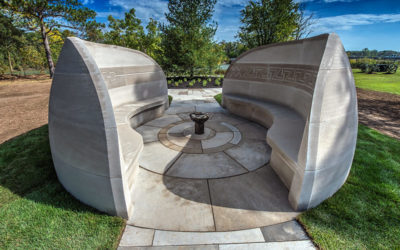
Monday’s Monument: First Nations Peace Monument, Thorold, Canada
Unveiled October 7, 2017, the monument, designed by Canadian architect and human rights activist Douglas Cardinal, was built to honor the First Nations contributions to the War of 1812 and to the creation of Canada. At the unveiling Cardinal, an Anishinaabe elder,...
read more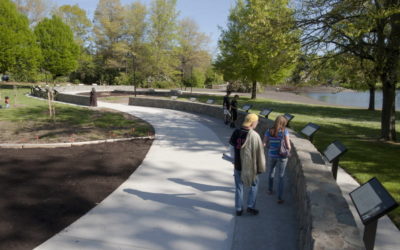
Monday’s Monument: Nobel Peace Park, Eugene, Oregon
The Nobel Peace Park covers one acre inside Alton Baker Park, a large city park on the east bank of the Willamette River across from downtown. Dedicated in 2013, in a double-spiraled wall, it honors, with biographical plaques, the 24 US recipients of the Nobel Peace...
read more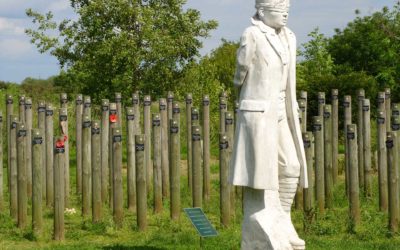
Monday’s Monument: Shot at Dawn Memorial, Staffordshire, England
The memorial, In the National Memorial Arboretum is to British Army and Commonwealth soldiers executed by firing squad during the First World War. It is alleged that soldiers accused of cowardice were often not given fair trials; they were often not properly defended,...
read more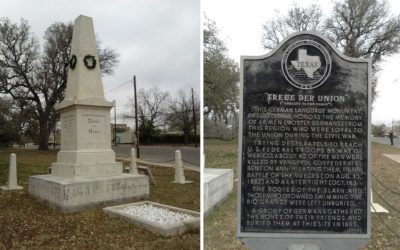
Monday’s Monument: Treue der Union Monument, Comfort, Texas
The German-language Treue der Union Monument (loyalty to the Union) was dedicated on August 10, 1866 to commemorate those who died at the 1862 Nueces massacre. In 1862, the Confederate States of America imposed martial law on Central Texas, due to resistance to the...
read more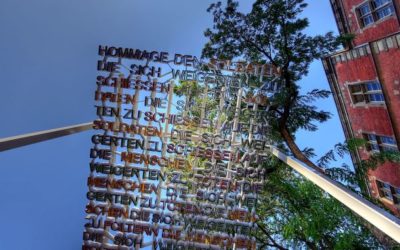
Monday’s Monument: Pergola of the Deserter, Cologne, Germany
In 2009, architect Ruedi Baur constructed a memorial in Cologne for those who have refused to fight. It is a bus shelter with these words on the roof: Homage to the soldiers who refused to shoot at the soldiers, who refused to shoot at the people, who refused to...
read more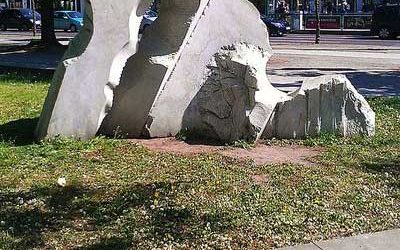
Monday’s Monument: Memorial to the Unknown Deserter, Potsdam, Germany
Between 1939 and 1945, about 400,000 German soldiers (2% of the total) deserted or attempted to desert, not counting those surrendering in battle. 30,000 of them were caught in the act, 23,000 of those were executed. This was the first of the monuments now in Germany...
read more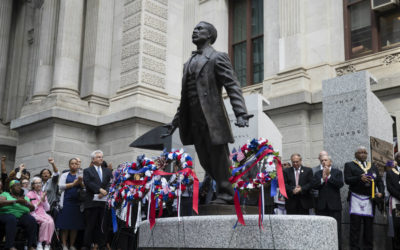
Monday’s Monument: A Quest for Parity (Octavius Catto Statue), Philadelphia, Pennsylvania
There are more than 1,500 statues on public land in the city of Philadelphia but, until last year, not one of them represents an African-American. This changed on 26 September, 2017 when A 12-foot bronze statue of Octavius V. Catto — 19th century educator, baseball...
read more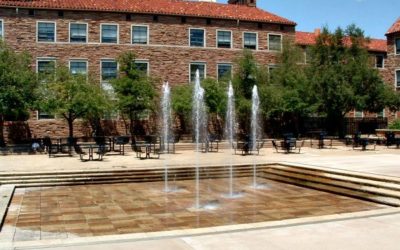
Monday’s Monument: Dalton Trumbo Fountain and Plaza, Boulder, Colorado
Colorado State grad student Kristina Baumli organized the effort to dedicate the fountain area on the north side of the University Memorial Center — frequently used for demonstrations and protests — to Dalton Trumbo, a Hollywood screenwriter who refused to testify at...
read more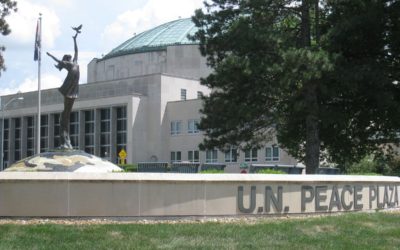
Monday’s Monument: United Nations Peace Plaza, Independence, Missouri
The United Nations Peace Plaza in Independence, Missouri was unveiled on October 27, 1997 commemorating the 50th Anniversary of the United Nations and formally dedicated by U.N. General Secretary Kofi Annan on April 25, 2003. It is described by its creators as "the...
read more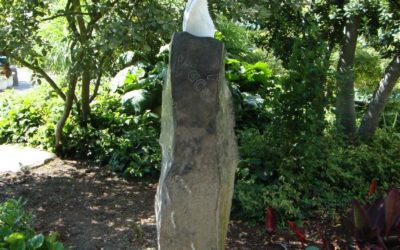
Monday’s Monument: Middle East Peace Sculpture, Seattle, Washington
The Middle East Peace Sculpture in Seattle's Peace Garden is located in the southeast portion of the Seattle Center near the base of the Space Needle. A graceful twist of Italian marble about 30 x 8 inches standing atop a natural column of black basalt. It depicts two...
read more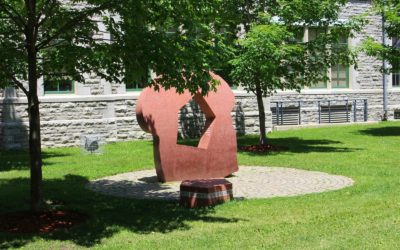
Monday’s Monument: Dorothy O’Connell Monument to Anti-Poverty Activism, Ottawa, Canada
Dorothy O'Connell is an activist, author, playwright and poet laureate of the poor. The monument that bears her name honors her anti-poverty work and focuses attention on the issue of ending poverty. The image is a slice of bread with a house removed from it. The...
read more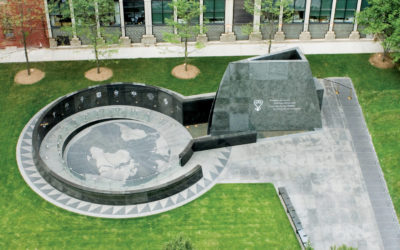
Monday’s Monument: African Burial Ground National Monument, New York, New York
African Burial Ground National Monument is a monument in the Civic Center section of Lower Manhattan, New York City. The site was designated a National Historic Landmark in 1993 and a National Monument in 2006 by President George W. Bush. Congress appropriated funds...
read more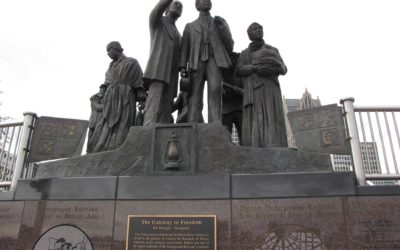
Monday’s Monument: International Memorial to the Underground Railroad
Sculpted by Ed Dwight and dedicated on October 20, 2001, the Gateway to Freedom International Memorial to the Underground Railroad pays tribute to Detroit's contribution and the thousands of railroad conductors who made freedom possible.For many the city was the final...
read more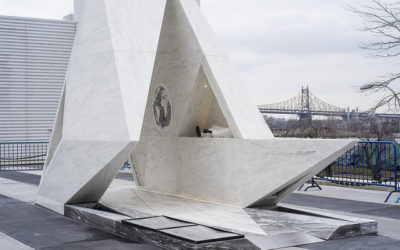
Monday’s Monument: Ark of Return, New York, New York
A sculpture commissioned by the United Nations to commemorate the end of slave trade was unveiled at UN Headquarters in New York on 25 March, 2015 to coincide with the International Day of remembrance for the victims of slavery. Visitors can pass through the Ark of...
read more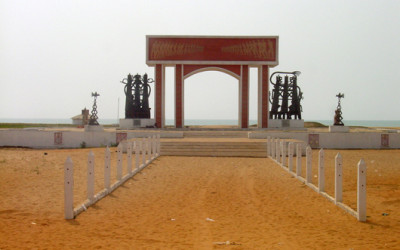
Monday’s Monument: Gateway of No Return, near Ouidah, Benin
A massive, arched gateway, 50 feet high, stands alone on the edge a beach in West Africa, a monument to the hundreds of thousands of Africans who were forced into slave boats on this beach, never to return. Etched across the top of the arch are two long lines of...
read more
If you
haven’t read
this book,
you should!
Ten Questions to Ask at a Historic Site
In his book Lies Across America, Professor James Loewen posed these ten questions to ask at a historic site.
1. When did this location become a historic site? (When was the marker or monument put up? Or the house interpreted?) How did that time differ from ours? From the time of the event or person interpreted?
2. Who sponsored it? representing which participant groups’s point of view? What was their position in the social structure when the event occurred? When the site went “up”?
3. What were the sponsor’s motives? What were their ideological needs and social purposes? What were their values?
4. What is the intended audience for the site? What values were they trying to leave for us, today? What does the site ask us to go and do or think about?
5. Did the sponsors have government support? At what level? Who was ruling the government at the time? What ideological arguments were used to get the government acquiescence?
6. Who is left out? What points of view go largely unheard? How would the story differ if a different group told it? Another political party? Race? Sex? Class? Religious group?
7. Are there problematic (insulting, degrading) words or symbols that would not be used today, or by other groups?
8. How is the site used today? Do traditional rituals continue to connect today’s public to it? Or is it ignored? Why?
9. Is the presentation accurate? What actually happened? What historical sources tell of the event, people, or period commemorated at this site?
10. How does the site fit in with others that treat the same era? Or subject? What other people lived ad events happened then but are not commemorated? Why?
Travel across the United States in a 1965 Airstream Trailer as filmmaker Tom Trinley visits historic sites and monuments unveiling the many sides of history not told on the landscape or in history books. On-camera appearances by Howard Zinn, James Loewen, Lonnie Bunch and Adam “Fortunate Eagle” Nordwall. Inspired by “Lies My Teacher Told Me” and “A Peoples’ History of the United States.”
At the Un-National Monument along the Canadian Border
By William E. Stafford
This is the field where the battle did not happen,
where the unknown soldier did not die.
This is the field where grass joined hands,
where no monument stands,
and the only heroic thing is the sky.
Birds fly here without any sound,
unfolding their wings across the open.
No people killed—or were killed—on this ground
hallowed by neglect and an air so tame
that people celebrate it by forgetting its name.
Of princes, shall outlive this powerful rhyme;
But you shall shine more bright in these contents
Than unswept stone besmear’d with sluttish time.
When wasteful war shall statues overturn,
And broils root out the work of masonry,
Nor Mars his sword nor war’s quick fire shall burn
The living record of your memory.
–William Shakespeare, from Sonnet 55

Listen to this song!
And we find it really hard to say we’re sorry
So the shadow of injustice still remains
We build monuments to those who died in battle
But we seldom speak of those who died in chains