
Request the Monuments Database
The weekly “Monday’s Monument” feature on this website is being fed from a database we are compiling that currently contains 200+ monuments. If you’d like a copy of the database, drop us a line.
Peace & Justice Monuments
Since May, 2015, every Monday morning the peaceCENTER has been posting a little essay about a peace or social justice monument. For more than a decade, ever since the peaceCENTER was contracted by a national peace & human rights group to develop a workshop exploring strategies for creating memorials about acts of violence and injustice that did not glorify the bloodshed, we have pondered the relationship between the landscape and civic memory.
“I would rather take care of the stomachs of the living than the glory of the departed in the form of monuments.”
Alfred Nobel
As we showcase these monuments we hope you will join us in this exploration. For now, we’re concentrating on publicly accessible outdoor works (indoor art, museums and historic sites may come later . . . ) Some are grassroots and homespun; others, more complicated in their funding and execution. They all have a story to tell and we can learn from all of them.
MONDAY’S MONUMENT
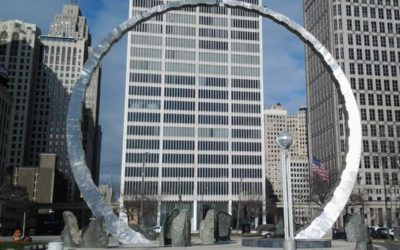
Monday’s Monument: Transcending (Labor Legacy Landmark), Detroit, Michigan
The shining arch rising 63 feet above the ground the Labor Legacy Landmark, "Transcending," is designed to celebrate the history and contributions of labor. Dedicated in 2003 and funded through donations from union members, it is the work of local sculptors David Barr...
read more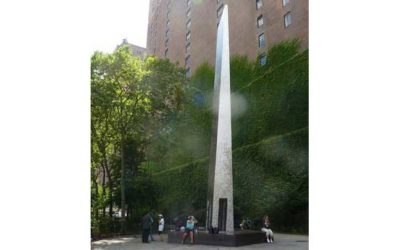
Monday’s Monument: Ralph Bunche Park, New York, New York
This is a small sliver of a park across from United Nations Plaza, but it packs a big punch into 4/10 of an acre. It is distinguished by four monuments. Peace Form One at the north end is a 50-foot high stainless steel shaft dedicated in 1980 as an homage to Bunche....
read more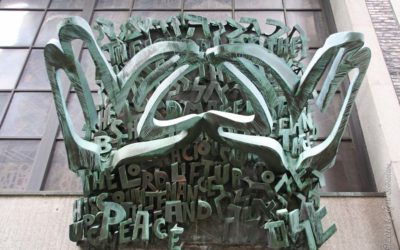
Monday’s Monument: Hands of Peace, Chicago, IL
Israeli artist Henri Azaz's abstract bronze work adorns the front of the Chicago Loop Synagogue, on S. Clark Street, above the door. Stylized hands in prayer, palms down, are featured in front of a blessing from the Bible’s Book of Numbers in both Hebrew and English:...
read more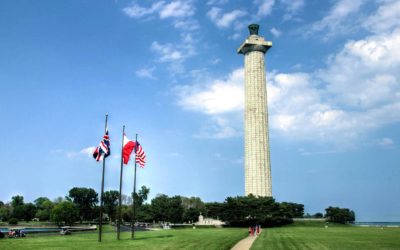
Monday’s Monument: Perry’s Victory and International Peace Memorial, Put-In-Bay, Ohio
Perry's Victory and International Peace Memorial commemorates the Battle of Lake Erie that took place near Ohio's South Bass Island, in which Commodore Oliver Hazard Perry led a fleet to victory in one of the most significant naval battles to occur in the War of 1812....
read more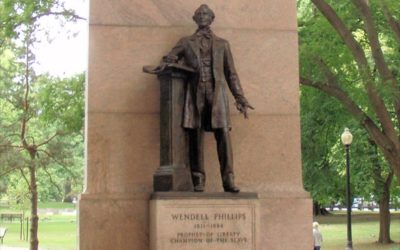
Monday’s Monument: Wendell Phillips Statue, Boston, Massachusetts
Wendell Phillips was a Boston lawyer who, in 1835, after hearing an impassioned speech by abolitionist William Lloyd Garrison, abandoned his practice and devoted the rest of his life to fighting slavery and other civil rights causes, including the rights of native...
read more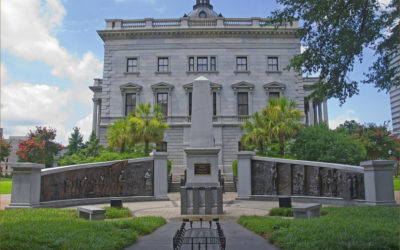
Monday’s Monument: African American Monument, Columbia, South Carolina
The first of its kind on any of the nation's state house grounds, this monument was dedicated March 29, 2001 as part of a compromise that also saw the removal of the Confederate flag from the statehouse dome, moved to a flagpole on the grounds. It traces...
read more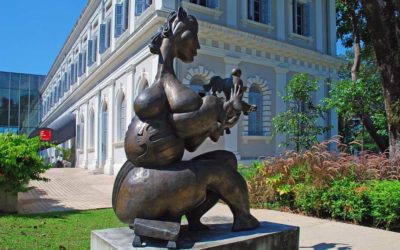
Monday’s Monument: Let There Be Peace, Singapore
In 1999, at the age of 15, Alexandra Nechita was named a United Nations ambassador of peace and goodwill through art. She had been brought to the US from Romania at the age of two, had sold her first painting at a library book sale at nine and was known throughout the...
read more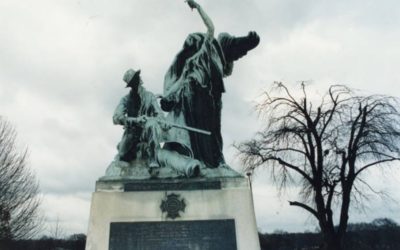
Monday’s Monument: Piedmont Park Angel of Peace, Atlanta, Georgia
Cease Firing - Peace is Proclaimed, or just the Peace Monument, sometimes referred to as Gate City Guard, was designed by sculptor Allen George Newman and dedicated in Piedmont Park on October 10, 1911. It depicts an angel staying the hand of a Confederate soldier as...
read more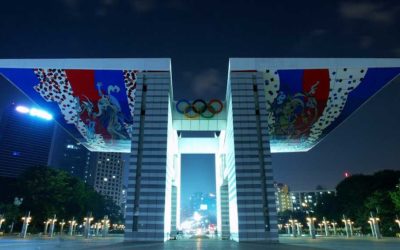
Monday’s Monument: World Peace Gate, Seoul, South Korea
Built in 1988 for the XXIV Olympiad in Seoul, the World Peace Gate towers nearly 80 feet and features a colorful mural depicting the four spirits (a phoenix, a turtle, a tiger and a dragon) by Korean artist Baik Kum Nam. Beneath the gate is an eternal flame with an...
read more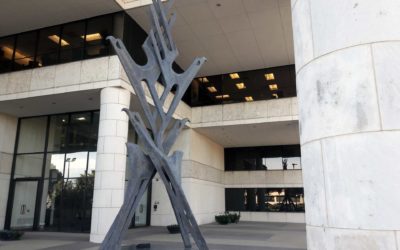
Monday’s Monument: Las Aves de la Libertad, San Antonio, Texas
"Birds of Freedom," installed by Mexican artist Victor Manuel Contreras in 1982, is at the entrance to the Pyramid Building (on the north side of Loop 410, across the highway from North Star Mall.) In the words of the artist, "The eagle, symbol of the Sun, of...
read more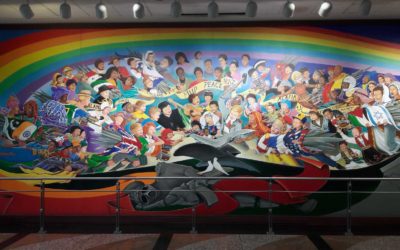
Monday’s Monument: Children of the World Dream of Peace, Denver, Colorado
Located in the Jeppesen Terminal of the Denver International Airport, Leo Tanguma's "Children of the World Dream of Peace" is a powerful mural expressing the artist's desire to abolish violence in society. One section of the piece speaks to the tragedy and devastation...
read more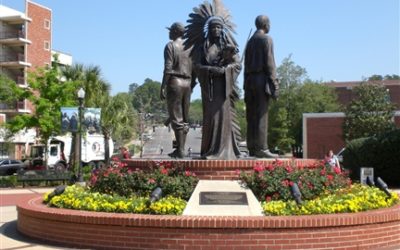
Monday’s Monument: Integration, FSU, Tallahassee, Florida
The Integration was unveiled during the FSU Heritage Day Celebration on January 30, 2004. It consists of three figures standing approximately nine feet tall on a circular brick pedestal. It is based on the concept of “books, bats, and beauty.” The “books” element is...
read more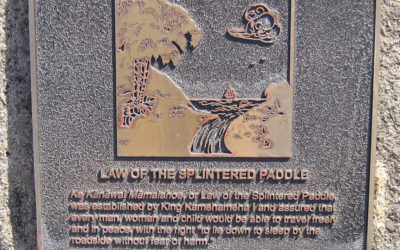
Monday’s Monument: Kānāwai Māmalahoe Plaque, Honolulu, Hawai’i
Legend has it that Kamehameha I, during his military campaign to unify the Hawai'ian islands, was chasing two non-combatant fishermen when his foot became caught in the reef. He was struck on the head by one of the panicked, fleeing fishermen with an oar, which broke...
read more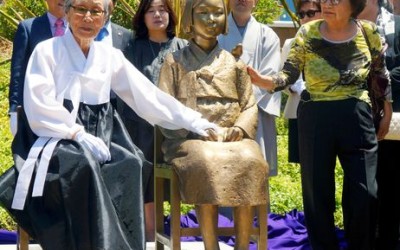
Monday’s Monument: Comfort Women Monument, Seoul, South Korea
Comfort women were women and girls forced into sexual slavery by the Japanese Army since 1910, before and during World War II. Estimates vary as to how many women were involved, with numbers ranging from as low as 20,000 to as high as 410,000. Many of the women were...
read more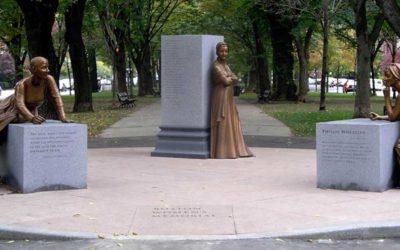
Monday’s Monument: Women’s Memorial, Boston, Massachusetts
In the late 1980s, a young girl on a class trip walking Boston’s Freedom Trail asked, “Where are the women?” She sparked a movement to make the landscape of Boston more inclusive. The Boston Women’s Memorial honors three important contributors to Boston’s rich...
read more
If you
haven’t read
this book,
you should!
Ten Questions to Ask at a Historic Site
In his book Lies Across America, Professor James Loewen posed these ten questions to ask at a historic site.
1. When did this location become a historic site? (When was the marker or monument put up? Or the house interpreted?) How did that time differ from ours? From the time of the event or person interpreted?
2. Who sponsored it? representing which participant groups’s point of view? What was their position in the social structure when the event occurred? When the site went “up”?
3. What were the sponsor’s motives? What were their ideological needs and social purposes? What were their values?
4. What is the intended audience for the site? What values were they trying to leave for us, today? What does the site ask us to go and do or think about?
5. Did the sponsors have government support? At what level? Who was ruling the government at the time? What ideological arguments were used to get the government acquiescence?
6. Who is left out? What points of view go largely unheard? How would the story differ if a different group told it? Another political party? Race? Sex? Class? Religious group?
7. Are there problematic (insulting, degrading) words or symbols that would not be used today, or by other groups?
8. How is the site used today? Do traditional rituals continue to connect today’s public to it? Or is it ignored? Why?
9. Is the presentation accurate? What actually happened? What historical sources tell of the event, people, or period commemorated at this site?
10. How does the site fit in with others that treat the same era? Or subject? What other people lived ad events happened then but are not commemorated? Why?
Travel across the United States in a 1965 Airstream Trailer as filmmaker Tom Trinley visits historic sites and monuments unveiling the many sides of history not told on the landscape or in history books. On-camera appearances by Howard Zinn, James Loewen, Lonnie Bunch and Adam “Fortunate Eagle” Nordwall. Inspired by “Lies My Teacher Told Me” and “A Peoples’ History of the United States.”
At the Un-National Monument along the Canadian Border
By William E. Stafford
This is the field where the battle did not happen,
where the unknown soldier did not die.
This is the field where grass joined hands,
where no monument stands,
and the only heroic thing is the sky.
Birds fly here without any sound,
unfolding their wings across the open.
No people killed—or were killed—on this ground
hallowed by neglect and an air so tame
that people celebrate it by forgetting its name.
Of princes, shall outlive this powerful rhyme;
But you shall shine more bright in these contents
Than unswept stone besmear’d with sluttish time.
When wasteful war shall statues overturn,
And broils root out the work of masonry,
Nor Mars his sword nor war’s quick fire shall burn
The living record of your memory.
–William Shakespeare, from Sonnet 55

Listen to this song!
And we find it really hard to say we’re sorry
So the shadow of injustice still remains
We build monuments to those who died in battle
But we seldom speak of those who died in chains