
Request the Monuments Database
The weekly “Monday’s Monument” feature on this website is being fed from a database we are compiling that currently contains 200+ monuments. If you’d like a copy of the database, drop us a line.
Peace & Justice Monuments
Since May, 2015, every Monday morning the peaceCENTER has been posting a little essay about a peace or social justice monument. For more than a decade, ever since the peaceCENTER was contracted by a national peace & human rights group to develop a workshop exploring strategies for creating memorials about acts of violence and injustice that did not glorify the bloodshed, we have pondered the relationship between the landscape and civic memory.
“I would rather take care of the stomachs of the living than the glory of the departed in the form of monuments.”
Alfred Nobel
As we showcase these monuments we hope you will join us in this exploration. For now, we’re concentrating on publicly accessible outdoor works (indoor art, museums and historic sites may come later . . . ) Some are grassroots and homespun; others, more complicated in their funding and execution. They all have a story to tell and we can learn from all of them.
MONDAY’S MONUMENT
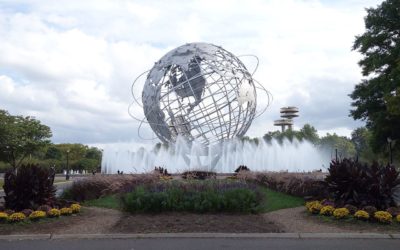
Monday’s Monument: Unisphere, Flushing Meadows, New York
Commissioned as part of the 1964 New York World's Fair, the Unisphere is a spherical stainless steel representation of the Earth, located in Flushing Meadows–Corona Park in the borough of Queens, New York City. It measures 140 feet high and 120 feet in diameter....
read more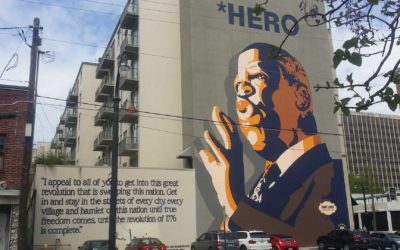
Monday’s Monument: John Lewis Hero Mural, Atlanta, Georgia
John Lewis moved to Atlanta as a founding leader of SNCC— the Student Nonviolent Coordinating Committee—with an impressive resume as an activist. As a Fisk University student he’d been arrested for leading sit-ins and protests. In 1961 he helped spearhead the Freedom...
read more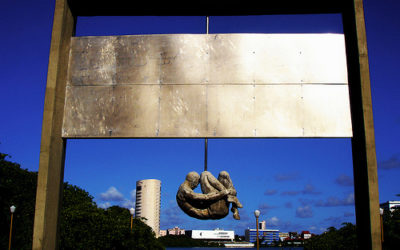
Monday’s Monument: Tortura Nunca Mais, Recife, Brazil
The Monument No More Torture is in Padre Henrique plaza in Recife, Pernambuco, Brazil. It was designed by the architect Demetrio Albuquerque in response to a city request for proposals. It was the first monument built in honor of the dead and disappeared during the...
read more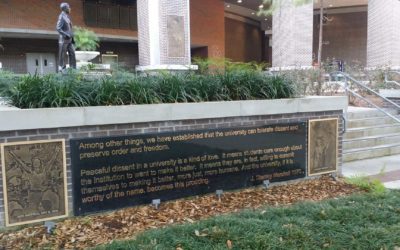
Monday’s Monument: Marshall Plaza FSU Protest Commemoration Plaques, Tallahassee, Florida
In the late 1960s and early 70s, Florida State University had a reputation as the "Berkeley of the South." Then-FSU President J. Stanley Marshall had what, in retrospect, was a straightforward policy for mass rallies and protests on campus. Organize any kind of...
read more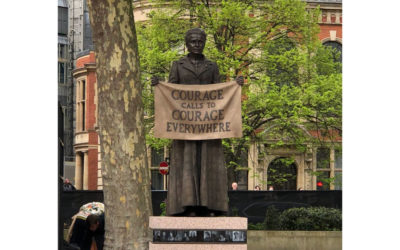
Today’s Monument: Courage Calls to Courage, London, England
Millicent Fawcett is the first woman to be commemorated with a statue in Parliament Square. It's also the first statue in the square designed by a woman, Gillian Wearing. It was dedicated on April 25, 2018. In 1866 at the age of 19 Fawcett collected signatures for the...
read more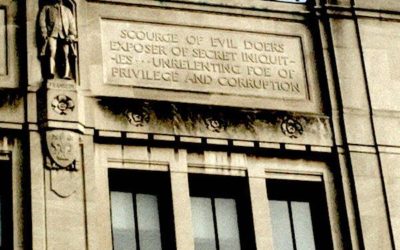
Monday’s Monument: Detroit News Building, Detroit, Michigan
The Detroit Evening News was founded in 1873 by newspaper tycoon James E. Scripps; in 1916, architect Albert Kahn was hired to design a new home for its operations. The Lafayette Boulevard facade features four statues by Corrado Parducci and five panels spelling out...
read more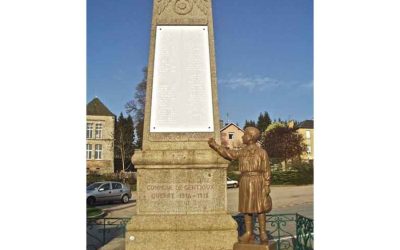
Monday’s Monument: Monument aux Morts, Gentioux, France
Erected in 1922, below the column which lists the name of the fallen of World War I, stands an orphan in bronze pointing to an inscription ‘Maudite soit la guerre’ (war be damned, or cursed be war.) Feelings ran so high that the memorial was not officially inaugurated...
read more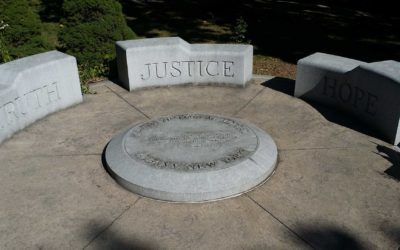
Monday’s Monument: Crime Victims Memorial, Albany, New York
The Albany County Crime Victims Memorial, installed in 1996, is located in downtown Academy Park. The three standing stones are engraved with the words Truth, Hope and Justice. The center medallion reads: "Justice can be secured only if those who are not injured feel...
read more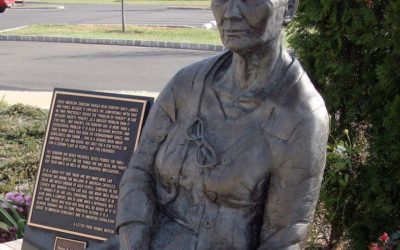
Monday’s Monument: Dorothy Day Statue, Colts Neck, New Jersey
In 1996, when the Reverend Fr. William J. Bausch retired from St. Marys Parish in Colts Neck-- a small town about 12 miles inland from the Jersey Shore -- he gifted his congregation with a statue of Dorothy Day. Dorothy Day (1897–1980) was the founder of the Catholic...
read more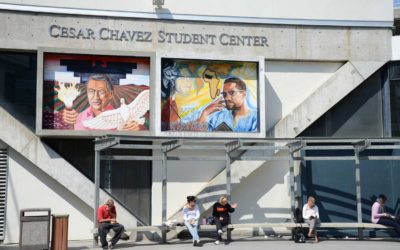
Monday’s Monument: Cesar Chavez Mural, San Francisco State University, California
This Cesar Chavez mural was dedicated on Cinco de Mayo (May 5) 1995 when SFSU renamed the student union as the Cesar Chavez Student Center. To learn about the symbolism, including the dove which represents nonviolence, hover over the larger image of the mural below....
read more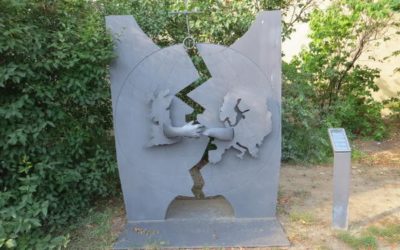
Monday’s Monument: Two Reconciliation Monuments, St. Stephan’s Churchyard, Würzburg, Germany
In the waning days of World War II, Würzburg, a city of no military but great historical importance, was reduced to a smoldering ruin in a British fire-bomb attack. Five years before, the Germans rained down the same fate on the English city of Coventry, destroying...
read more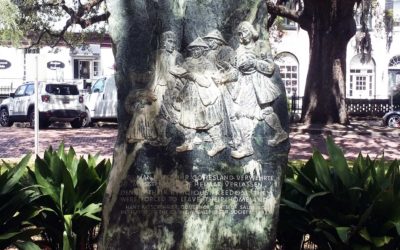
Monday’s Monument: Salzburger Monument of Reconciliation, Savannah, Georgia
Salzburger Park, a half-acre piece of land next to Emmett Park in Savannah, was the very place, on March 12, 1734, that first group of German-speaking Lutherans, known as the Salzburgers, landed in Georgia and were welcomed by General James Edward Oglethorpe. They...
read more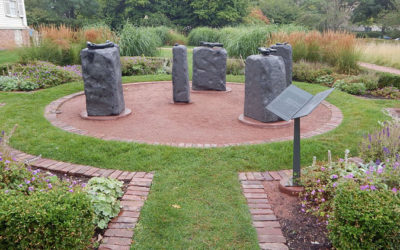
Monday’s Monument: Helping Hands Jane Addams Memorial, Chicago, Illinois
Helping Hands commemorates Nobel Peace Prize winner and social reformer Jane Addams (1860–1935), who established Hull House (the nation’s first settlement house), advocated for women’s rights and founded the Women’s International League for Peace and Freedom. The...
read more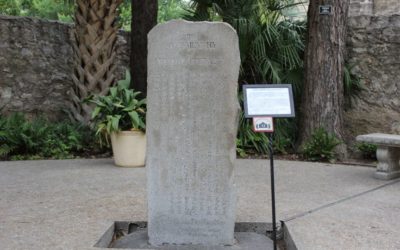
Monday’s Monument: Dr. Shiga’s Alamo Monument, San Antonio, Texas
There are times when monuments ostensibly erected to glorify war also have a side that glorifies peace. Two monuments, one in Okazaki, Japan and one in the Alamo courtyard in San Antonio, bear these words commemorating the Alamo defenders and comparing their battle to...
read more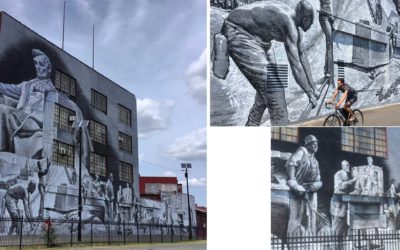
Monday’s Monument: 28 Blocks Mural, Washington, DC
“28 Blocks” by New York artist Garin Baker is on the Metropolitan Branch Trail — a pedestrian and cyclist commuter trail in Northeast Washington. It is visible from the New York Ave. Bridge. The mural is a tribute to the men — many of whom were the first and second...
read more
If you
haven’t read
this book,
you should!
Ten Questions to Ask at a Historic Site
In his book Lies Across America, Professor James Loewen posed these ten questions to ask at a historic site.
1. When did this location become a historic site? (When was the marker or monument put up? Or the house interpreted?) How did that time differ from ours? From the time of the event or person interpreted?
2. Who sponsored it? representing which participant groups’s point of view? What was their position in the social structure when the event occurred? When the site went “up”?
3. What were the sponsor’s motives? What were their ideological needs and social purposes? What were their values?
4. What is the intended audience for the site? What values were they trying to leave for us, today? What does the site ask us to go and do or think about?
5. Did the sponsors have government support? At what level? Who was ruling the government at the time? What ideological arguments were used to get the government acquiescence?
6. Who is left out? What points of view go largely unheard? How would the story differ if a different group told it? Another political party? Race? Sex? Class? Religious group?
7. Are there problematic (insulting, degrading) words or symbols that would not be used today, or by other groups?
8. How is the site used today? Do traditional rituals continue to connect today’s public to it? Or is it ignored? Why?
9. Is the presentation accurate? What actually happened? What historical sources tell of the event, people, or period commemorated at this site?
10. How does the site fit in with others that treat the same era? Or subject? What other people lived ad events happened then but are not commemorated? Why?
Travel across the United States in a 1965 Airstream Trailer as filmmaker Tom Trinley visits historic sites and monuments unveiling the many sides of history not told on the landscape or in history books. On-camera appearances by Howard Zinn, James Loewen, Lonnie Bunch and Adam “Fortunate Eagle” Nordwall. Inspired by “Lies My Teacher Told Me” and “A Peoples’ History of the United States.”
At the Un-National Monument along the Canadian Border
By William E. Stafford
This is the field where the battle did not happen,
where the unknown soldier did not die.
This is the field where grass joined hands,
where no monument stands,
and the only heroic thing is the sky.
Birds fly here without any sound,
unfolding their wings across the open.
No people killed—or were killed—on this ground
hallowed by neglect and an air so tame
that people celebrate it by forgetting its name.
Of princes, shall outlive this powerful rhyme;
But you shall shine more bright in these contents
Than unswept stone besmear’d with sluttish time.
When wasteful war shall statues overturn,
And broils root out the work of masonry,
Nor Mars his sword nor war’s quick fire shall burn
The living record of your memory.
–William Shakespeare, from Sonnet 55

Listen to this song!
And we find it really hard to say we’re sorry
So the shadow of injustice still remains
We build monuments to those who died in battle
But we seldom speak of those who died in chains