
Request the Monuments Database
The weekly “Monday’s Monument” feature on this website is being fed from a database we are compiling that currently contains 200+ monuments. If you’d like a copy of the database, drop us a line.
Peace & Justice Monuments
Since May, 2015, every Monday morning the peaceCENTER has been posting a little essay about a peace or social justice monument. For more than a decade, ever since the peaceCENTER was contracted by a national peace & human rights group to develop a workshop exploring strategies for creating memorials about acts of violence and injustice that did not glorify the bloodshed, we have pondered the relationship between the landscape and civic memory.
“I would rather take care of the stomachs of the living than the glory of the departed in the form of monuments.”
Alfred Nobel
As we showcase these monuments we hope you will join us in this exploration. For now, we’re concentrating on publicly accessible outdoor works (indoor art, museums and historic sites may come later . . . ) Some are grassroots and homespun; others, more complicated in their funding and execution. They all have a story to tell and we can learn from all of them.
MONDAY’S MONUMENT
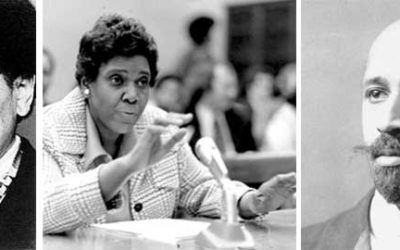
Happy Birthday, Peacemakers!
February 18, 1934 Audre Lorde "When we speak we are afraid our words will not be heard or welcomed. But when we are silent, we are still afraid. So it is better to speak." February 21, 1936 Barbara Jordan "What a better world it would be if we all, the whole world,...
read more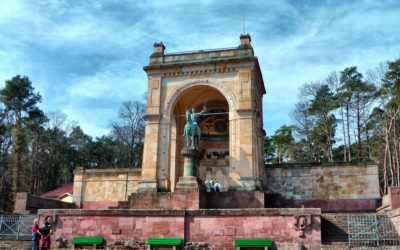
Monday’s Monument: Friedensdenkmal, Edenkoben, Germany
This was built in 1899 as a Siegesdenkmal — victory monument — over the French in the Franco-Prussian War (1870/71), on the edge of the Pfaltzwald. Because of its location, one can see across the Rhine all the way to Strasbourg (there are stairs in the back leading to...
read more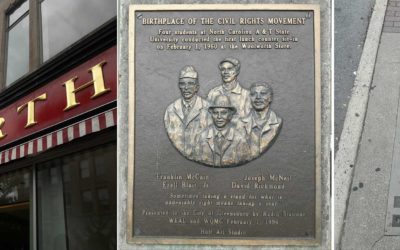
Monday’s Monument: Woolworth’s Sit-down Plaque & Footsteps, Greensboro, North Carolina
On February 1, 1960 four black students from North Carolina Agricultural and Technical State University—Joseph McNeil, Franklin McCain, Ezell Blair Jr. and David Richmond—sat down at a segregated Woolworth's lunch counter in downtown Greensboro and started a movement....
read more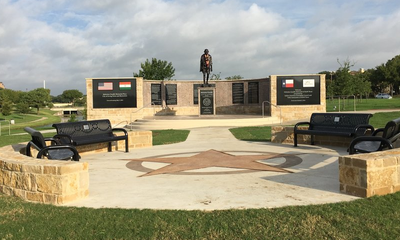
Monday’s Monument: Mahatma Gandhi Memorial Plaza, Irving, Texas
More than 200,000 Indian-Americans live in the Dallas-Forth Worth metro area. In 2010 they formed an organization to erect a monument to Mohandas K. Gandhi. The Hon. Nikki Randhawa Haley, the first female and the first Indian American Governor of South Carolina and...
read more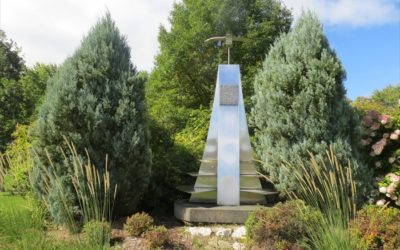
Monday’s Monument: Jeunes du Monde, Nicolet, Québec, Canada
"Youth of the World" is an obelisk topped with a flying dove, located in a city park. The text is in both French and English: For us / Youth of the World / Justice and peace are essential / These values urge us to change the world / One heart at a time / First of all...
read more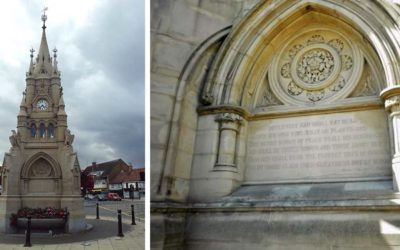
Monday’s Monument: American Fountain, Stratford-Upon-Avon, England
The drinking fountain and clock tower in the market square of Stratford-Upon-Avon was the gift of Philadelphia Ledger publisher, antiquarian and philanthropist George Childs, donated for the Golden Jubilee of Queen Victoria. It was unveiled in 1887 by the actor Henry...
read more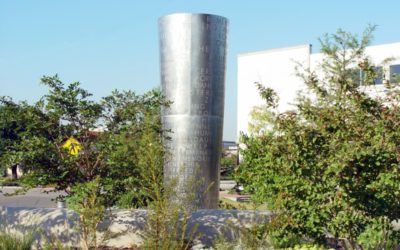
Monday’s Monument: International Peace & Friendship Monument, Arlington, TX
The sister city relationship between Arlington, Texas and Bad Königshofen in Bavaria began when a German official on an exchange program stopped in Arlington and related how hard things were in his city. Not only were they suffering from post-war shortages, but their...
read more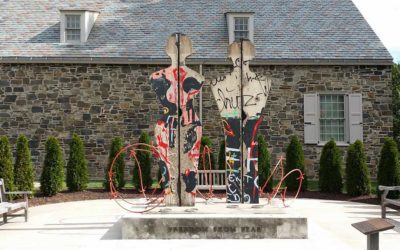
Monday’s Monument: BreakFree, Hyde Park, New York
Hyde Park was the home of Franklin Roosevelt. Outside the Presidential Library, in the Freedom Plaza, is BreakFree, constructed of pieces of the Berlin Wall (which fell in November, 1989.) It was installed in 1994. The sculpture is by Edwina Sandys, granddaughter of...
read more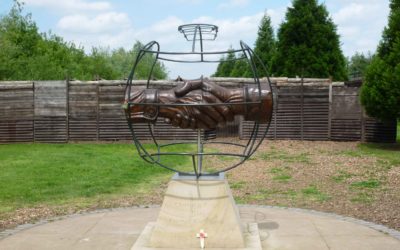
Monday’s Monument: Christmas Truce Memorial, Staffordshire, England
The Christmas Truce Memorial was dedicated by The Duke of Cambridge Prince Harry on December 12, 2014, the 100th anniversary of an informal truce between British and German troops in the trenches of France during World War I, in which they sang carols, exchanged gifts...
read more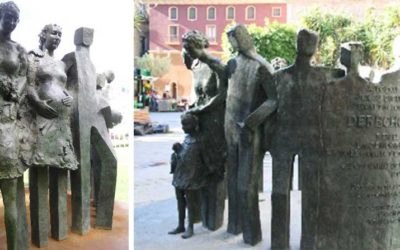
Monday’s Monument: Monumento de Derechos Humanos, Murcia, Spain
This Tribute to Human Rights, by Mariano González Beltrán, was dedicated on December 15, 2004 and is located in the Plaza de Santo Domingo. Composed of numerous figures cast in bronze and arranged in a circle, it represents "a society that lives in harmony, in harmony...
read more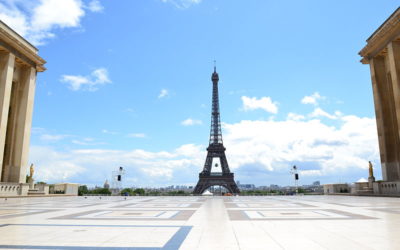
Monday’s Monument: Esplanade des Droits de L’homme, Paris, France
On December 10, 1948 the Universal Declaration of Human Rights was adopted by the United Nations, which held its fifth General Assembly at the Palais de Chaillot, in Paris. In 1985, at the entrance of the forecourt, an engraved slab was dedicated and the esplanade was...
read more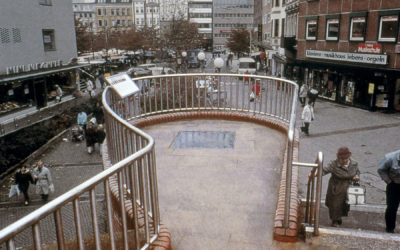
Monday’s Monument: Monument Against Fascism, War, and Violence-and for Peace and Human Rights, Hamburg/Harberg, Germany
Commissioned by the city, artists Jochen Gerz and Esther Shalev-Gerz described their design as a Gegen-Denkmal––a countermonument. They rejected the city of Hamburg's offer to place it in a park and instead constructed it in a pedestrian shopping mall in the...
read more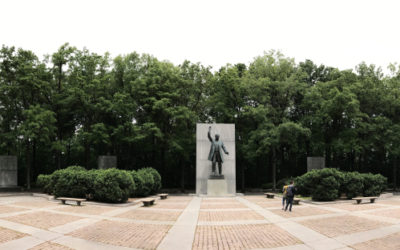
Monday’s Monument: Theodore Roosevelt Island National Memorial, Washington, D.C.
It is perhaps a stretch to call the Teddy Roosevelt memorial a peace monument, as the only reference to peace on the four slabs that are engraved with his quotations falls not on the side of peace. "If I must chose between righteousness and peace, I chose righteous,"...
read more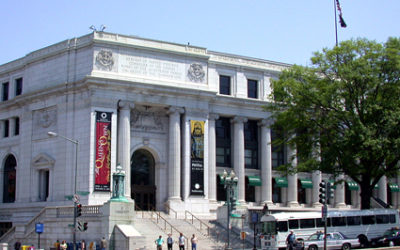
Monday’s Monument: “The Letter,” US Postal Museum, Washington, DC
At a peaceCENTER's meeting last week we were talking about the postal service and Andy quoted this poem, engraved on the pediments of the old District of Columbia Post office, now the Smithsonian's National Postal Museum, at N. Capitol & Massachusetts Ave, NE, on...
read more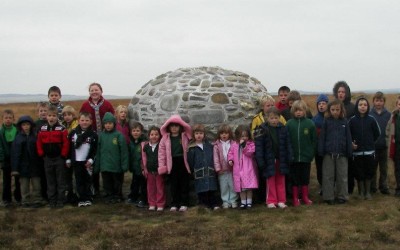
Monday’s Monument: Carn Heddwch, Mynydd Llanfihangel Rhos y Corn, Wales
The Carn Heddwch (Peace Cairn) was constructed on Mynydd Llanfihangel Rhos y Corn, Carmarthenshire, in the Autumn of 2007. It has the word peace carved in four languages: Arabic, English, Hebrew and Welsh on different sides of the monument. The children of Brechfa...
read more
If you
haven’t read
this book,
you should!
Ten Questions to Ask at a Historic Site
In his book Lies Across America, Professor James Loewen posed these ten questions to ask at a historic site.
1. When did this location become a historic site? (When was the marker or monument put up? Or the house interpreted?) How did that time differ from ours? From the time of the event or person interpreted?
2. Who sponsored it? representing which participant groups’s point of view? What was their position in the social structure when the event occurred? When the site went “up”?
3. What were the sponsor’s motives? What were their ideological needs and social purposes? What were their values?
4. What is the intended audience for the site? What values were they trying to leave for us, today? What does the site ask us to go and do or think about?
5. Did the sponsors have government support? At what level? Who was ruling the government at the time? What ideological arguments were used to get the government acquiescence?
6. Who is left out? What points of view go largely unheard? How would the story differ if a different group told it? Another political party? Race? Sex? Class? Religious group?
7. Are there problematic (insulting, degrading) words or symbols that would not be used today, or by other groups?
8. How is the site used today? Do traditional rituals continue to connect today’s public to it? Or is it ignored? Why?
9. Is the presentation accurate? What actually happened? What historical sources tell of the event, people, or period commemorated at this site?
10. How does the site fit in with others that treat the same era? Or subject? What other people lived ad events happened then but are not commemorated? Why?
Travel across the United States in a 1965 Airstream Trailer as filmmaker Tom Trinley visits historic sites and monuments unveiling the many sides of history not told on the landscape or in history books. On-camera appearances by Howard Zinn, James Loewen, Lonnie Bunch and Adam “Fortunate Eagle” Nordwall. Inspired by “Lies My Teacher Told Me” and “A Peoples’ History of the United States.”
At the Un-National Monument along the Canadian Border
By William E. Stafford
This is the field where the battle did not happen,
where the unknown soldier did not die.
This is the field where grass joined hands,
where no monument stands,
and the only heroic thing is the sky.
Birds fly here without any sound,
unfolding their wings across the open.
No people killed—or were killed—on this ground
hallowed by neglect and an air so tame
that people celebrate it by forgetting its name.
Of princes, shall outlive this powerful rhyme;
But you shall shine more bright in these contents
Than unswept stone besmear’d with sluttish time.
When wasteful war shall statues overturn,
And broils root out the work of masonry,
Nor Mars his sword nor war’s quick fire shall burn
The living record of your memory.
–William Shakespeare, from Sonnet 55

Listen to this song!
And we find it really hard to say we’re sorry
So the shadow of injustice still remains
We build monuments to those who died in battle
But we seldom speak of those who died in chains