
Request the Monuments Database
The weekly “Monday’s Monument” feature on this website is being fed from a database we are compiling that currently contains 200+ monuments. If you’d like a copy of the database, drop us a line.
Peace & Justice Monuments
Since May, 2015, every Monday morning the peaceCENTER has been posting a little essay about a peace or social justice monument. For more than a decade, ever since the peaceCENTER was contracted by a national peace & human rights group to develop a workshop exploring strategies for creating memorials about acts of violence and injustice that did not glorify the bloodshed, we have pondered the relationship between the landscape and civic memory.
“I would rather take care of the stomachs of the living than the glory of the departed in the form of monuments.”
Alfred Nobel
As we showcase these monuments we hope you will join us in this exploration. For now, we’re concentrating on publicly accessible outdoor works (indoor art, museums and historic sites may come later . . . ) Some are grassroots and homespun; others, more complicated in their funding and execution. They all have a story to tell and we can learn from all of them.
MONDAY’S MONUMENT
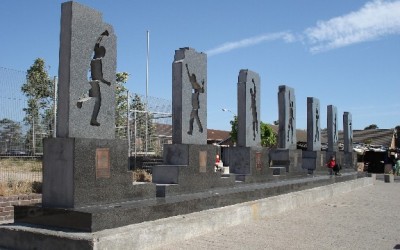
Monday’s Monument: Gugulethu Seven Monument, Gugulethu, South Africa
This monument recalls the brutal murder of seven young black activists by South African security forces in 1986. The young men were on their way to what they believed to be a job interview in a minivan driven by an undercover security officer, when they stopped at a...
read more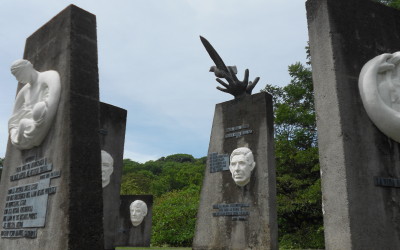
Monday’s Monument: Monument to Disarmament, Work & Peace, San Jose, Costa Rica
On the campus of the University for Peace (the only university chartered by the United Nations) this monument, sculpted by Cuban artist Thelvia Marín in 1987, includes nine 12-foot columns hosting a sculpture on each side. The columns are lined up in a spiral,...
read more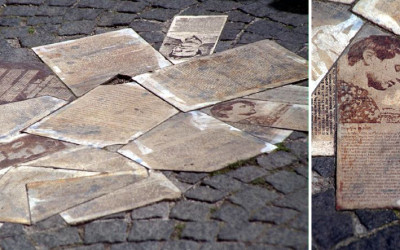
Monday’s Monument: The White Rose, Munich, Germany
The White Rose (German: die Weiße Rose) was a non-violent, intellectual resistance group in Nazi Germany, consisting of students from the University of Munich and their philosophy professor. The group became known for an anonymous leaflet and graffiti campaign,...
read more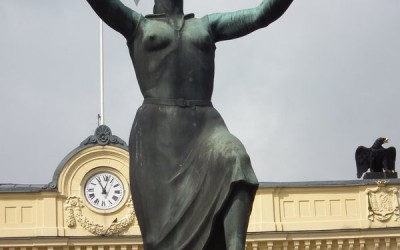
Monday’s Monument: Fredsmonumentet, Karlstad
In front of Rådhuset is this bronze monument, called Fredsmonumentet (the monument of peace). It was created in 1955 by the artist Ivar Johnsson, to commemorate a celebration of the peaceful dissolution of the union of Sweden and Norway in 1905, which was...
read more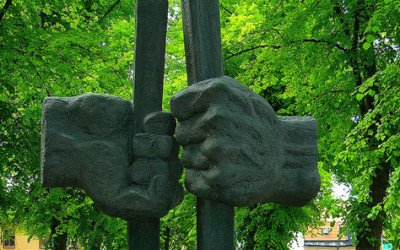
Monday’s Monument: Befrielsen / Liberation, Uppsala, Sweden
In a Medieval plaza facing the city's university, artist Olof Hellström depicts two large fists removing rods from the ground, symbolizing Dr. Martin Luther King's message that the best way to solve a problem is to remove the cause. Or perhaps it is two large hands...
read more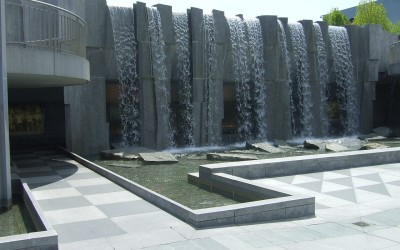
Monday’s Monument: Revelation, San Francisco, CA
The San Francisco Martin Luther King, Jr. Memorial is located behind a 50-foot-wide, 20-foot-high granite waterfall, downtown near the Convention Center, in Yerba Buena Gardens. It consists of large, etched glass excerpts of King's speeches in the languages of San...
read more
Monday’s Monument: Avery C. Alexander Statue, New Orleans, LA
The statue of Southern Christian Leadership Conference board member, state legislator and local civil rights hero the Rev. Avery C. Alexander was removed in the wake of Hurricane Katrina (2005) so that it would not be damaged by the demolition of the State Building in...
read more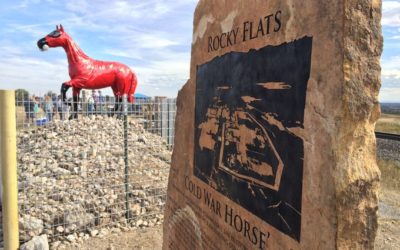
Monday’s Monument: Cold War Horse, Arvada, Colorado
“Cold War Horse” was created to acknowledge the history of Rocky Flats Nuclear Weapons Plant, its workers, and the surrounding community. During its operation Rocky Flats manufactured parts for nuclear bombs; an estimated 70,000 plutonium triggers were produced at the...
read more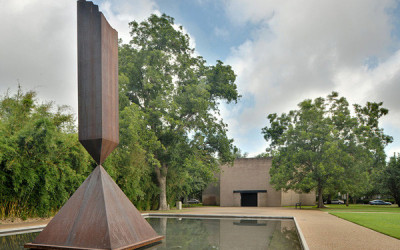
Monday’s Monument: Broken Obelisk, Houston, Texas
In 1969 art collectors Dominique and John de Menil offered to purchase Barnett Newman's Broken Obelisk, considered by many the finest sculpture of the 20th Century, as a memorial to Dr. Martin Luther King, Jr., to be installed downtown, in front of Houston's City...
read more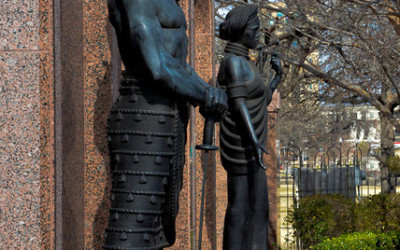
Monday’s Monument: Freedmen’s Memorial, Dallas, Texas
The story of this memorial starts in the 1930s when the Central Expressway, now part of IH-75, displaced part of a pre-Civil War African-American cemetery. Rather than respectfully move the remains (as is required by law), the city paved over them, turning the...
read more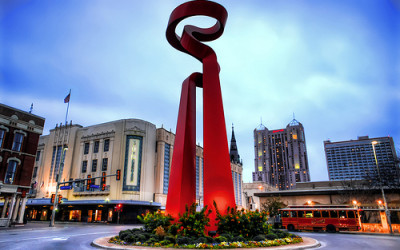
Monday’s Monument: La Antorcha de la Amistad / Torch of Friendship, San Antonio, TX
The artist of the sculpture is world-renowned Mexican sculptor, Sebastián, and was commissioned by the Asociación de Empresarios Mexicanos AEM (Mexican Entrepreneur Association). The sculpture was presented as a gift from the Mexican government to the City of San...
read more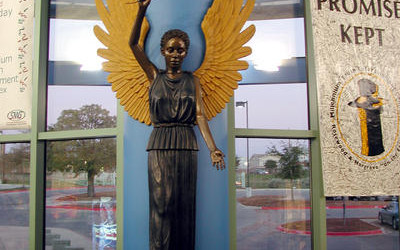
Monday’s Monument: Spirit of Hope, Austin, Texas
The Millennium Youth Entertainment Complex was built to provide neighborhood youth with safe entertainment options, in response to a 1992 drive-by shooting of a teenager. David Newton was commissioned to create a commemorative sculpture and fountain for the center....
read more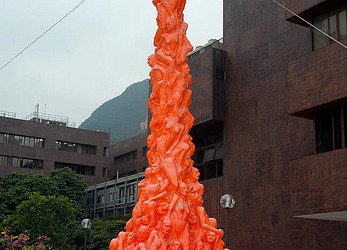
Monday’s Monument: Pillar of Shame, Hong Kong, China
This sculpture was created by Danish sculptor-activist Jens Galschiot to mark the 8th anniversary of the 4th of June Tiananmen Square protests (1989). The fifty torn and twisted bodies of the sculpture symbolize the degradation, devaluation and lack of respect for the...
read more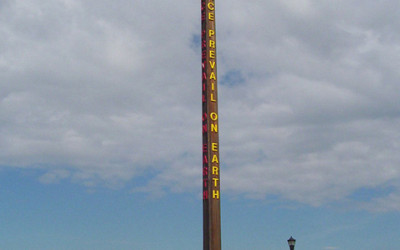
Monday’s Monument: Peace Park Playground, Janesville, WI
The Peace Park Playground at Rockport Park promotes peace and unity in the community by giving children a chance to learn about cultural diversity as they play. It was constructed by 2,500 community volunteers and $175,000 in donations. In includes a two-story Native...
read more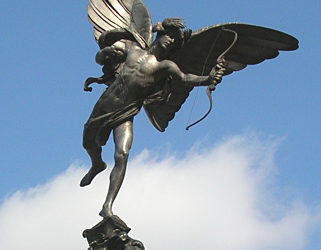
Monday’s Monument: Shaftesbury Memorial Fountain, London, England
Ask a hundred people congregated at Piccadilly Circus in London, “ who's the statue atop the fountain?” and they'll tell you “Eros.” You know – Cupid. They'd be wrong. The god pictured is Eros' younger brother, Anteros, who represents completed or returned love....
read more
If you
haven’t read
this book,
you should!
Ten Questions to Ask at a Historic Site
In his book Lies Across America, Professor James Loewen posed these ten questions to ask at a historic site.
1. When did this location become a historic site? (When was the marker or monument put up? Or the house interpreted?) How did that time differ from ours? From the time of the event or person interpreted?
2. Who sponsored it? representing which participant groups’s point of view? What was their position in the social structure when the event occurred? When the site went “up”?
3. What were the sponsor’s motives? What were their ideological needs and social purposes? What were their values?
4. What is the intended audience for the site? What values were they trying to leave for us, today? What does the site ask us to go and do or think about?
5. Did the sponsors have government support? At what level? Who was ruling the government at the time? What ideological arguments were used to get the government acquiescence?
6. Who is left out? What points of view go largely unheard? How would the story differ if a different group told it? Another political party? Race? Sex? Class? Religious group?
7. Are there problematic (insulting, degrading) words or symbols that would not be used today, or by other groups?
8. How is the site used today? Do traditional rituals continue to connect today’s public to it? Or is it ignored? Why?
9. Is the presentation accurate? What actually happened? What historical sources tell of the event, people, or period commemorated at this site?
10. How does the site fit in with others that treat the same era? Or subject? What other people lived ad events happened then but are not commemorated? Why?
Travel across the United States in a 1965 Airstream Trailer as filmmaker Tom Trinley visits historic sites and monuments unveiling the many sides of history not told on the landscape or in history books. On-camera appearances by Howard Zinn, James Loewen, Lonnie Bunch and Adam “Fortunate Eagle” Nordwall. Inspired by “Lies My Teacher Told Me” and “A Peoples’ History of the United States.”
At the Un-National Monument along the Canadian Border
By William E. Stafford
This is the field where the battle did not happen,
where the unknown soldier did not die.
This is the field where grass joined hands,
where no monument stands,
and the only heroic thing is the sky.
Birds fly here without any sound,
unfolding their wings across the open.
No people killed—or were killed—on this ground
hallowed by neglect and an air so tame
that people celebrate it by forgetting its name.
Of princes, shall outlive this powerful rhyme;
But you shall shine more bright in these contents
Than unswept stone besmear’d with sluttish time.
When wasteful war shall statues overturn,
And broils root out the work of masonry,
Nor Mars his sword nor war’s quick fire shall burn
The living record of your memory.
–William Shakespeare, from Sonnet 55

Listen to this song!
And we find it really hard to say we’re sorry
So the shadow of injustice still remains
We build monuments to those who died in battle
But we seldom speak of those who died in chains