
Request the Monuments Database
The weekly “Monday’s Monument” feature on this website is being fed from a database we are compiling that currently contains 200+ monuments. If you’d like a copy of the database, drop us a line.
Peace & Justice Monuments
Since May, 2015, every Monday morning the peaceCENTER has been posting a little essay about a peace or social justice monument. For more than a decade, ever since the peaceCENTER was contracted by a national peace & human rights group to develop a workshop exploring strategies for creating memorials about acts of violence and injustice that did not glorify the bloodshed, we have pondered the relationship between the landscape and civic memory.
“I would rather take care of the stomachs of the living than the glory of the departed in the form of monuments.”
Alfred Nobel
As we showcase these monuments we hope you will join us in this exploration. For now, we’re concentrating on publicly accessible outdoor works (indoor art, museums and historic sites may come later . . . ) Some are grassroots and homespun; others, more complicated in their funding and execution. They all have a story to tell and we can learn from all of them.
MONDAY’S MONUMENT
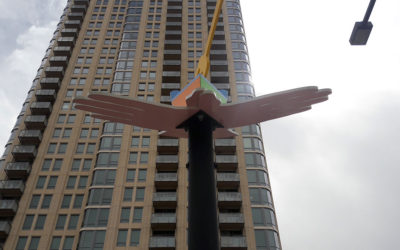
Monday’s Monument: Peace of Pie Please, Salt Lake City, Utah
Starting in 2005, Salt Lake City started installing "flying objects" in prominent places downtown. Artists were commissioned to create art that could stand the harsh winters for at least two years. "Peace of Pie Please," by Stephen Dayton, is one of six installed atop...
read more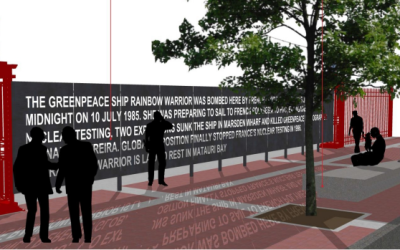
Monday’s Monument: Proposed Rainbow Warrior Memorial, Auckland, New Zealand
In the Summer of 2015, Ports of Auckland proposed building a monument to the bombing of the Rainbow Warrior on the city's waterfront. The Greenpeace vessel was sunk in a terrorist attack while it was moored at Marsden Wharf in July 1985. The wharf is being demolished...
read more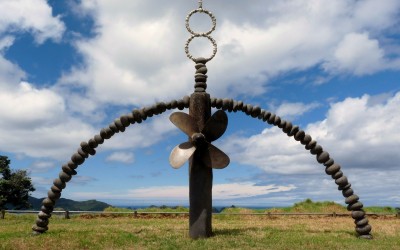
Monday’s Monument: Rainbow Warrior Memorial, Matauri Bay, New Zealand
On a headland at the northern end of this beach sits the Rainbow Warrior memorial, an early work of Chris Booth, a New Zealand sculptor. The memorial site, a brisk 15 minute walk from the beach, has majestic views towards the Cavalli Islands where the Rainbow Warrior...
read more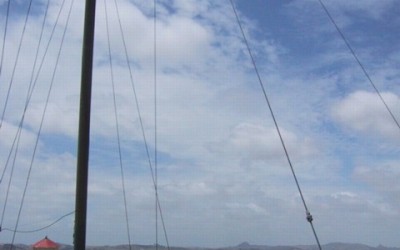
Monday’s Monument: Rainbow Warrior Masts, Dargaville, New Zealand
The Rainbow Warrior's masts were first "stepped" (ceremoniously raised) at Dargaville Museum in 1986, commemorating the bombing of Greenpeace's anti-nuclear protest flagship in Auckland Harbor on July 10, 1985. The ship was preparing to depart from Auckland to protest...
read more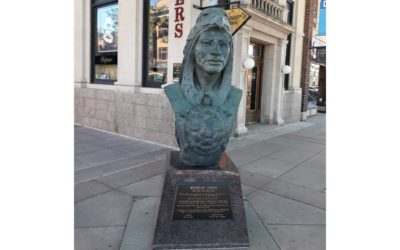
Monday’s Monument: Mitakuye Oyasin (All My Relations), Rapid City, SD
Rapid City South Dakota (pop. about 70,000) is a city filled with statues. In 2000 it declared itself the "city of presidents" and installed a life-size statue of one on each street corner. Before the presidents started appearing, though, there was Mitakuye Oyasin --...
read more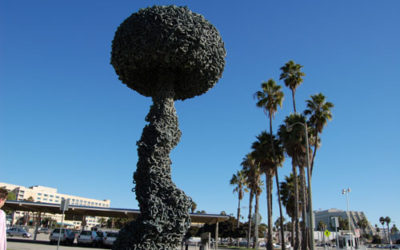
Monday’s Monument: Chain Reaction, Santa Monica, California
Chain Reaction depicts a mushroom cloud created by a nuclear explosion. Designed by American editorial cartoonist Paul Conrad and built by Peter M. Carlson, the 26-foot high sculpture was installed in 1991 adjacent to the Santa Monica Civic Center. An inscription at...
read more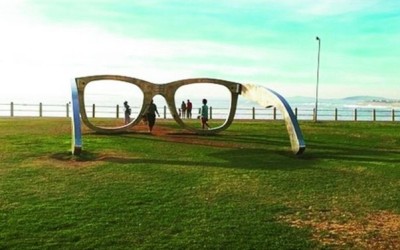
Monday’s Monument: Perceiving Freedom, Cape Town, South Africa
In 2014 a giant pair of Ray-Ban Wayfarers appeared on Cape Town's Sea Point Promenade, pointed towards Robben Island, where Nelson Mandela was incarcerated for 18 of his 27 years as a prisoner. The artist, Michael Elion, pitched it as a public art installation; the...
read more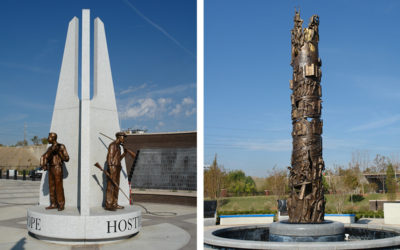
Monday’s Monument: John Hope Franklin Tower of Reconciliation, Tulsa, Oklahoma
This park, dedicated in 2010, is a result of the 2001 Oklahoma Commission to Study the Tulsa Race Riot of 1921, during which a group of Whites attacked what was then the wealthiest Black community in the US. An estimated 10,000 Blacks were left homeless, and 35 city...
read more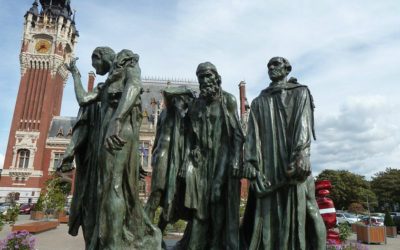
Monday’s Monument: Burghers of Calais, Calais, France
In 1347, after the Battle of Crécy, the English King Edward III laid siege to the French port city of Calais. In exchange for lifting the siege, he demanded that six prominent citizens – burghers – surrender themselves at the gate, with nooses around their necks,...
read more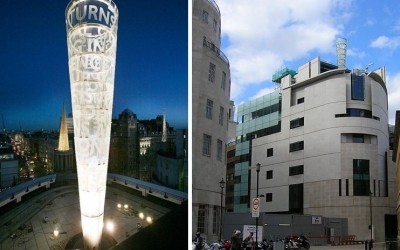
Monday’s Monument: Breathing, London, England
Breathing is a memorial sculpture situated on the roof of the Peel Wing of BBC Broadcasting House, in London. The sculpture commemorates journalists and associated staff who have been killed while carrying out their work. It consists of a 10-metre high glass and steel...
read more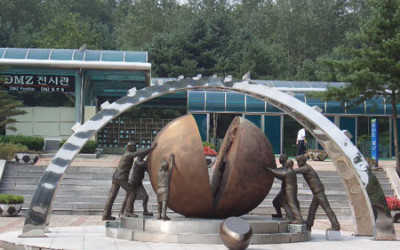
Monday’s Monument: This One Earth, DMZ, South Korea
The Demilitarized Zone is a strip of land running across the Korean Peninsula; it was established as part of the armistice agreement in 1953 to serve as a buffer zone between North and South Korea. Since 1974, the South Koreans have discovered four infiltration...
read more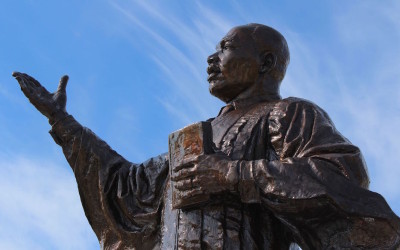
Monday’s Monument: Martin Luther King Statue and Plaza, Houston, TX
Thirty years ago a group of Black activists planted a tree to mark the place, on a median on MLK Blvd, where they wanted to install a statue of Martin Luther King. In 2012 the tree had to be removed when Metro, Houston's transit authority, began construction on its...
read more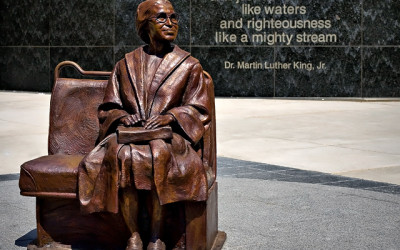
Monday’s Monument: Rosa Parks Plaza, Dallas, TX
This Rosa Parks statue was installed in 2009 in a new Rosa Parks Plaza, a transportation hub for buses and light rail in the Dallas West End, near Dealy Plaza. There is room on the bench for commuters to sit with Rosa for a while, and they do. Behind her is a...
read more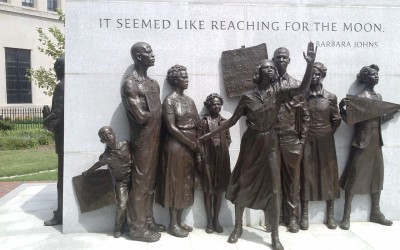
Monday’s Monument: Civil Rights Monument, Richmond, VA
This monument, located on the statehouse grounds, commemorates protests which helped bring about school desegregation in Virginia. Opened in July 2008, it features eighteen statues of leaders or participants in the Civil Rights Movement on four sides of a rectangular...
read more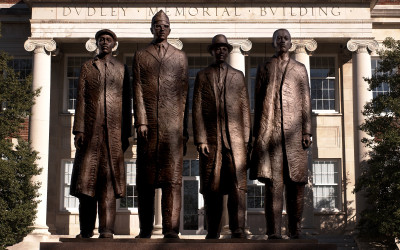
Monday’s Monument: A&T Lunchcounter Four, Greensboro, NC
On Monday, February 1, 1960, Greensboro went down in history for the igniting the civil rights “sit-in” movement in the nation. On this day, four North Carolina. A&T State University students sat down at the F.W. Woolworth Company’s segregated lunch counter and asked...
read more
If you
haven’t read
this book,
you should!
Ten Questions to Ask at a Historic Site
In his book Lies Across America, Professor James Loewen posed these ten questions to ask at a historic site.
1. When did this location become a historic site? (When was the marker or monument put up? Or the house interpreted?) How did that time differ from ours? From the time of the event or person interpreted?
2. Who sponsored it? representing which participant groups’s point of view? What was their position in the social structure when the event occurred? When the site went “up”?
3. What were the sponsor’s motives? What were their ideological needs and social purposes? What were their values?
4. What is the intended audience for the site? What values were they trying to leave for us, today? What does the site ask us to go and do or think about?
5. Did the sponsors have government support? At what level? Who was ruling the government at the time? What ideological arguments were used to get the government acquiescence?
6. Who is left out? What points of view go largely unheard? How would the story differ if a different group told it? Another political party? Race? Sex? Class? Religious group?
7. Are there problematic (insulting, degrading) words or symbols that would not be used today, or by other groups?
8. How is the site used today? Do traditional rituals continue to connect today’s public to it? Or is it ignored? Why?
9. Is the presentation accurate? What actually happened? What historical sources tell of the event, people, or period commemorated at this site?
10. How does the site fit in with others that treat the same era? Or subject? What other people lived ad events happened then but are not commemorated? Why?
Travel across the United States in a 1965 Airstream Trailer as filmmaker Tom Trinley visits historic sites and monuments unveiling the many sides of history not told on the landscape or in history books. On-camera appearances by Howard Zinn, James Loewen, Lonnie Bunch and Adam “Fortunate Eagle” Nordwall. Inspired by “Lies My Teacher Told Me” and “A Peoples’ History of the United States.”
At the Un-National Monument along the Canadian Border
By William E. Stafford
This is the field where the battle did not happen,
where the unknown soldier did not die.
This is the field where grass joined hands,
where no monument stands,
and the only heroic thing is the sky.
Birds fly here without any sound,
unfolding their wings across the open.
No people killed—or were killed—on this ground
hallowed by neglect and an air so tame
that people celebrate it by forgetting its name.
Of princes, shall outlive this powerful rhyme;
But you shall shine more bright in these contents
Than unswept stone besmear’d with sluttish time.
When wasteful war shall statues overturn,
And broils root out the work of masonry,
Nor Mars his sword nor war’s quick fire shall burn
The living record of your memory.
–William Shakespeare, from Sonnet 55

Listen to this song!
And we find it really hard to say we’re sorry
So the shadow of injustice still remains
We build monuments to those who died in battle
But we seldom speak of those who died in chains