
Request the Monuments Database
The weekly “Monday’s Monument” feature on this website is being fed from a database we are compiling that currently contains 200+ monuments. If you’d like a copy of the database, drop us a line.
Peace & Justice Monuments
Since May, 2015, every Monday morning the peaceCENTER has been posting a little essay about a peace or social justice monument. For more than a decade, ever since the peaceCENTER was contracted by a national peace & human rights group to develop a workshop exploring strategies for creating memorials about acts of violence and injustice that did not glorify the bloodshed, we have pondered the relationship between the landscape and civic memory.
“I would rather take care of the stomachs of the living than the glory of the departed in the form of monuments.”
Alfred Nobel
As we showcase these monuments we hope you will join us in this exploration. For now, we’re concentrating on publicly accessible outdoor works (indoor art, museums and historic sites may come later . . . ) Some are grassroots and homespun; others, more complicated in their funding and execution. They all have a story to tell and we can learn from all of them.
MONDAY’S MONUMENT
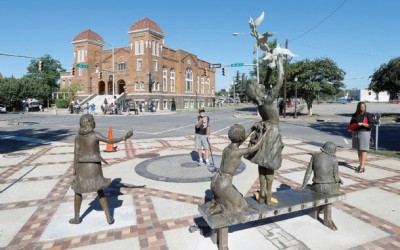
Monday’s Monument: Kelly Ingram Park Statues, Birmingham, AL
Once known as West Park, Kelly Ingram sits on a 4-acre lot in the Birmingham Civil Rights District, just across the street from both the Birmingham Civil Rights Institute and the 16th Street Baptist Church. The Park oftentimes served as a gathering place for...
read more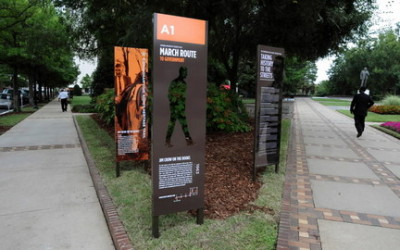
Monday’s Monument: Civil Rights Heritage Trail, Birmingham, AL
The Birmingham Civil Rights Heritage Trail winds through downtown, marking significant locations along the 1963 Civil Rights march routes. Designed as a self-guided tour, the route directs visitors along this historic pathway by maps at each location. The trail speaks...
read more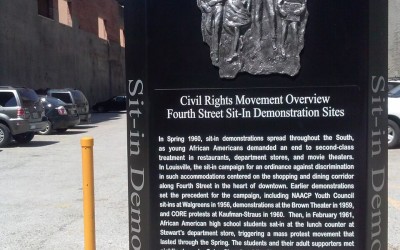
Monday’s Monument: Civil Rights Trail, Louisville, KY
This trail consists of eleven markers along Fourth Street in downtown Louisville, the city's primary corridor of restaurants, department stores and theaters. Through the 1950s, most white-owned establishments downtown excluded African Americans or treated them...
read more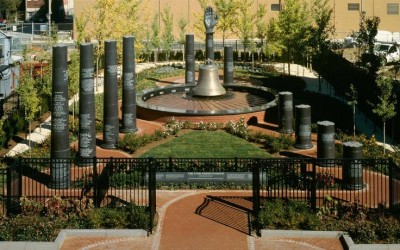
Monday’s Monument: Civil Rights Garden, Atlantic City, New Jersey
Designed by Larry Kirkland of Washington, D.C., the garden features a brick path through a garden of seasonal plants, flowers and ginkgo trees. Eleven black African granite columns are inscribed with quotes from slaves and students, presidents and preachers, all...
read more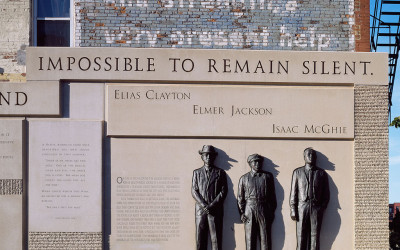
Monday’s Monument: Lynching Monument, Duluth, MN
On June 15, 1920, Black circus workers Elmer Jackson, Elias Clayton, and Issac McGhie, falsely accused of rape, were hanged in Duluth while a white mob of 10,000 looked on. The lynchings made headlines throughout the whole country. The Chicago Evening Post wrote,...
read more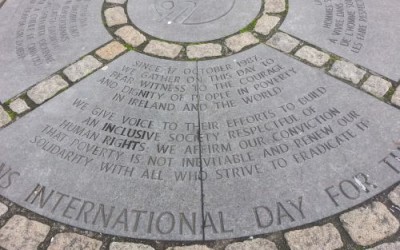
Monday’s Monument: World Poverty Stone, Dublin, Ireland
The World Poverty Stone is a commemorative stone marking the United Nations International Day for the Eradication of World Poverty. It is sited to the east of the Famine Sculptures on Custom House Quay in the heart of Dublin's Docklands. This limestone memorial was...
read more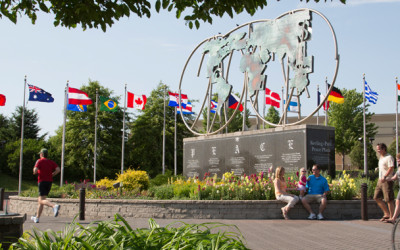
Monday’s Monument: Keeling-Puri Peace Plaza, Rockford, IL
The Keeling-Puri Peace Plaza was erected by the families of Virgil Keeling of Rockford and Amanath Puri of Mumbai to honor the vision of the two men, righteousness in the heart and peace in the world. The 15 foot by 34 foot sculpture “Harmony Atlas" sits atop a 7 foot...
read more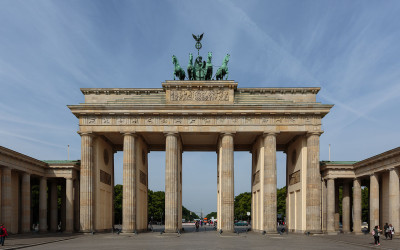
Monday’s Monument: Brandenburg Gate, Berlin, Germany
We close our monumental tour of Berlin with the Brandenburg Gate, an archetypal example of how the symbolism of monuments evolves. The Gate was commissioned by King Frederick William II of Prussia and, when completed in 1791, was named the Peace Gate (German:...
read more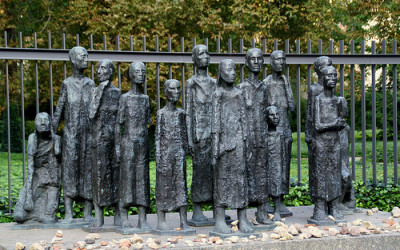
Monday’s Monument: Monument to the Jewish victims of fascism, Berlin, Germany
Große Hamburger Straße is in the Hackescher Markt district of Berlin. In the pre-war years it housed a Jewish cemetery, school and home for the elderly. On 11 March 1942, the SS ordered the school’s closure. Its doors were shut on 30th June and the Gestapo turned it –...
read more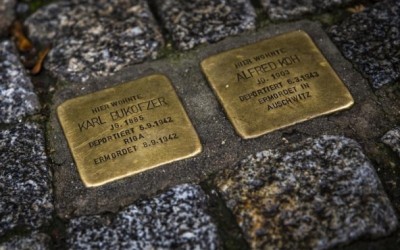
Monday’s Monument: Stolpersteine, throughout Europe
A stolperstein (literally, “stumbling blocks”) is a type of monument created by artist Gunter Demnig to commemorate victims of Nazi oppression, including the Holocaust. Stolpersteins are small, cobblestone-sized memorials for individual victims of Nazism. They...
read more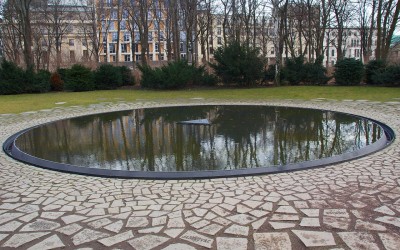
Monday’s Monument: Memorial to the Sinti and Roma Victims of National Socialism, Berlin, Germany
The Memorial to the Sinti and Roma Victims of National Socialism is dedicated to the memory of the 220,000 - 500,000 people murdered in the Porajmos – the Nazi genocide of the European Sinti and Roma peoples. The memorial is on Simsonweg in the Tiergarten in Berlin,...
read more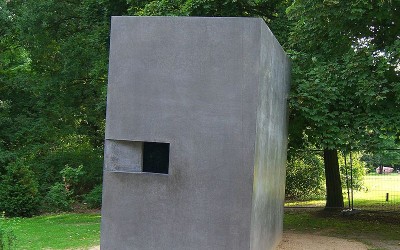
Monday’s Monument: Memorial to Homosexuals Persecuted Under Nazism, Berlin, Germany
Designed by artists Michael Elmgreen and Ingar Dragset, the Cuboid (German: Denkmal für die im Nationalsozialismus verfolgten Homosexuellen) is made of concrete. On the front side of the cuboid is a window, through which visitors can see a short film of two kissing...
read more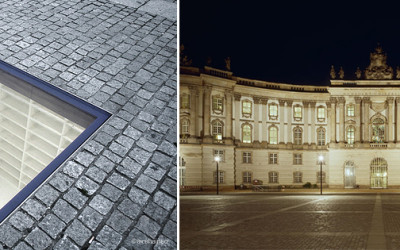
Monday’s Monument: Bibliotek, Berlin, Germany
Bebelplatz, on the south side of Unter den Linden, was conceived by Friedrich II in the 1750's as a central area for science and the arts for Berlin. It contains the Opera house (home to the famed Berlin Symphony), St. Hedwigs Cathedral and the old library of Humbolt...
read more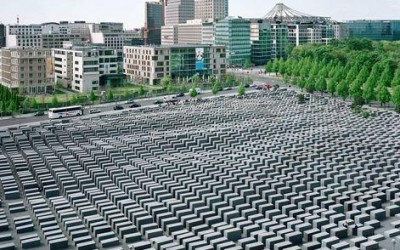
Monday’s Monument: Memorial to the Murdered Jews of Europe, Berlin, Germany
The Memorial to the Murdered Jews of Europe (German: Denkmal für die ermordeten Juden Europas), was designed by architect Peter Eisenman and engineer Buro Happold. It consists of a 4.7-acre site covered with 2,711 concrete slabs or "stelae", arranged in a grid pattern...
read more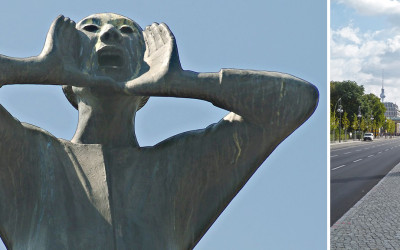
Monday’s Monument: Der Rufer, Berlin, Germany
“The Caller" is in the middle of Straße des 17. Juni, facing the Brandenburg Gate. A quotation from the Italian poet Francesco Petrarch is inscribed on the base: "I wander through the world and cry ‘Peace, Peace, Peace.' This bronze sculpture is 3 meters tall and was...
read more
If you
haven’t read
this book,
you should!
Ten Questions to Ask at a Historic Site
In his book Lies Across America, Professor James Loewen posed these ten questions to ask at a historic site.
1. When did this location become a historic site? (When was the marker or monument put up? Or the house interpreted?) How did that time differ from ours? From the time of the event or person interpreted?
2. Who sponsored it? representing which participant groups’s point of view? What was their position in the social structure when the event occurred? When the site went “up”?
3. What were the sponsor’s motives? What were their ideological needs and social purposes? What were their values?
4. What is the intended audience for the site? What values were they trying to leave for us, today? What does the site ask us to go and do or think about?
5. Did the sponsors have government support? At what level? Who was ruling the government at the time? What ideological arguments were used to get the government acquiescence?
6. Who is left out? What points of view go largely unheard? How would the story differ if a different group told it? Another political party? Race? Sex? Class? Religious group?
7. Are there problematic (insulting, degrading) words or symbols that would not be used today, or by other groups?
8. How is the site used today? Do traditional rituals continue to connect today’s public to it? Or is it ignored? Why?
9. Is the presentation accurate? What actually happened? What historical sources tell of the event, people, or period commemorated at this site?
10. How does the site fit in with others that treat the same era? Or subject? What other people lived ad events happened then but are not commemorated? Why?
Travel across the United States in a 1965 Airstream Trailer as filmmaker Tom Trinley visits historic sites and monuments unveiling the many sides of history not told on the landscape or in history books. On-camera appearances by Howard Zinn, James Loewen, Lonnie Bunch and Adam “Fortunate Eagle” Nordwall. Inspired by “Lies My Teacher Told Me” and “A Peoples’ History of the United States.”
At the Un-National Monument along the Canadian Border
By William E. Stafford
This is the field where the battle did not happen,
where the unknown soldier did not die.
This is the field where grass joined hands,
where no monument stands,
and the only heroic thing is the sky.
Birds fly here without any sound,
unfolding their wings across the open.
No people killed—or were killed—on this ground
hallowed by neglect and an air so tame
that people celebrate it by forgetting its name.
Of princes, shall outlive this powerful rhyme;
But you shall shine more bright in these contents
Than unswept stone besmear’d with sluttish time.
When wasteful war shall statues overturn,
And broils root out the work of masonry,
Nor Mars his sword nor war’s quick fire shall burn
The living record of your memory.
–William Shakespeare, from Sonnet 55

Listen to this song!
And we find it really hard to say we’re sorry
So the shadow of injustice still remains
We build monuments to those who died in battle
But we seldom speak of those who died in chains