
Request the Monuments Database
The weekly “Monday’s Monument” feature on this website is being fed from a database we are compiling that currently contains 200+ monuments. If you’d like a copy of the database, drop us a line.
Peace & Justice Monuments
Since May, 2015, every Monday morning the peaceCENTER has been posting a little essay about a peace or social justice monument. For more than a decade, ever since the peaceCENTER was contracted by a national peace & human rights group to develop a workshop exploring strategies for creating memorials about acts of violence and injustice that did not glorify the bloodshed, we have pondered the relationship between the landscape and civic memory.
“I would rather take care of the stomachs of the living than the glory of the departed in the form of monuments.”
Alfred Nobel
As we showcase these monuments we hope you will join us in this exploration. For now, we’re concentrating on publicly accessible outdoor works (indoor art, museums and historic sites may come later . . . ) Some are grassroots and homespun; others, more complicated in their funding and execution. They all have a story to tell and we can learn from all of them.
MONDAY’S MONUMENT
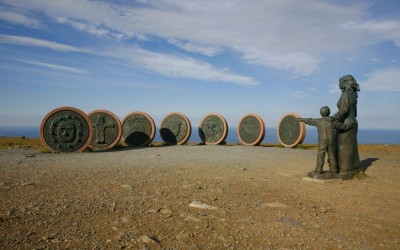
Monday’s Monument: Children of the World, Nordkapp, Norway
The “Children of the World” sculpture was started in 1988 when author Simon Flem Devold randomly selected seven children from seven countries – Tanzania, Brazil, USA, Japan, Thailand, Italy and Russia — to visit the North Cape to dream of “Peace on Earth“." During...
read more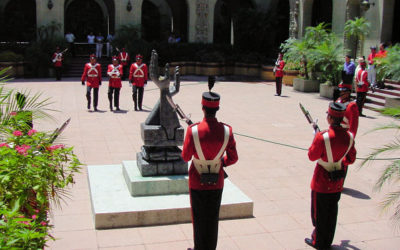
Monday’s Monument: Monument to Peace, Guatemala City, Guatemala
This bronze statue, sometimes called "The Palm of Peace," is in the courtyard of the National Palace, on the site of the signing of a peace to end Guatemala's 36-year-long civil war in 1996. This statue represents two left hands reaching up, representing each side of...
read more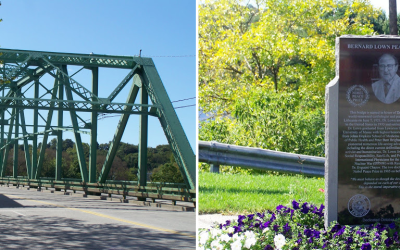
Monday’s Monument: Bernard Lown Peace Bridge, Lewiston, Maine
The Bernard Lown Peace Bridge that crosses the Androscoggin River honors Dr. Bernard Lown, a world-renowned cardiologist & peace activist. Born in Lithuania on June 7, 1921, Dr. Lown and his family emigrated to the USA in 1935 & settled in Lewiston. He pioneered...
read more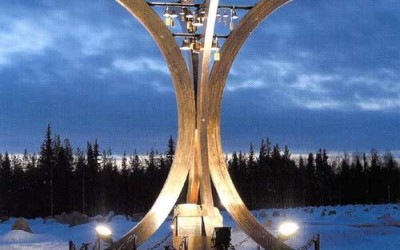
Monday’s Monument: Winter War Monument, Suomussalmi, Finland
The Winter War began with the Soviet invasion of Finland on 30 November 1939, and ended with the Moscow Peace Treaty on 13 March 1940. The League of Nations deemed the attack illegal and expelled the Soviet Union from the League on 14 December 1939. Finland ceded...
read more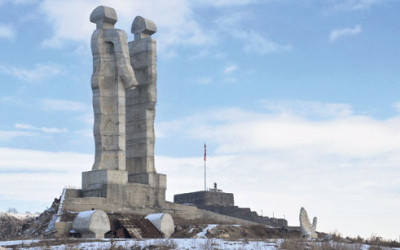
Monday’s Monument: Monument to Humanity, Kars, Turkey
It looked like a good sign when a former mayor of Kars, Turkey commissioned sculptor Mehmet Aksoy to build his “Monument to Humanity”: two large figures—a divided human—that stood almost 100-feet tall and included a giant hand, palm open and facing toward Armenia....
read more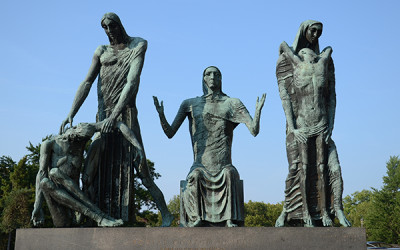
Monday’s Monument: Social Consciousness, Philadelphia, PA
At the West Entrance of the Philadelphia Museum of Art, the elongated figures of Jacob Epstein’s Social Consciousness (1954) suggest sympathy, tenderness and sorrow for human suffering. The three parts of Social Consciousness are (left to right) The Great Consoler (or...
read more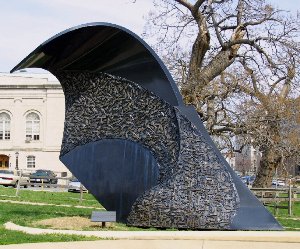
Monday’s Monument: Guns Into Plowshares, Washington, DC
This monument was fashioned in 1995 by Mennonites Esther K Augsburger and her son, Michael, from 3,000 guns collected by the District of Columbia Police in a buyback program funded by heavyweight boxing champ Riddick Bowe. The inspiration was Isaiah 2:4: "They shall...
read more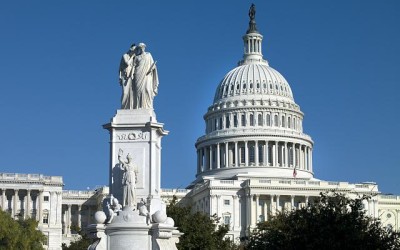
Monday’s Monument: Peace Monument, Washington, DC
Most descriptions of the elaborate statue that stands in Peace Circle in front of the US Capitol begin, "The Peace Monument is a war memorial . . . " It was erected in 1877-78 to commemorate naval deaths at sea during the Civil War, and was originally intended to be...
read more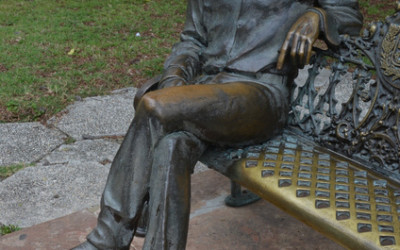
Monday’s Monument: John Lennon Statue, Havana, Cuba
In the John Lennon Park at 17th and 6th in Havana is a sculpture of former Beatle John Lennon, sculpted by Cuban artist José Villa Soberón. On a marble tile at the foot of the bench there is an inscription: “Dirás que soy un soñador pero no soy el único," the Spanish...
read more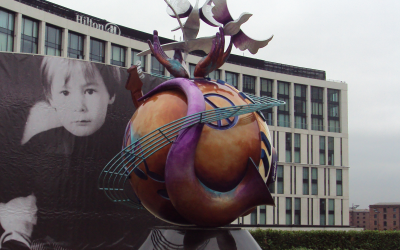
Monday’s Monument: John Lennon Peace Monument, Liverpool, England
The John Lennon Peace Monument, also known as the European Peace Monument, is dedicated to the memory of John Lennon in his birthplace, Liverpool, England. It was unveiled by his son Julian and first wife, Cynthia Lennon in 2010 to celebrate what would have been John...
read more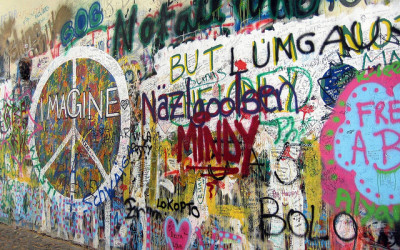
Monday’s Monument: John Lennon Peace Wall, Prague, Czech Republic
When John Lennon was murdered in 1980 he became a hero to many youth in what was then communist-ruled Czechoslovakia and his picture was painted on a wall in Mala Strana, near the French Embassy, along with graffiti defying the authorities. By doing this, those young...
read more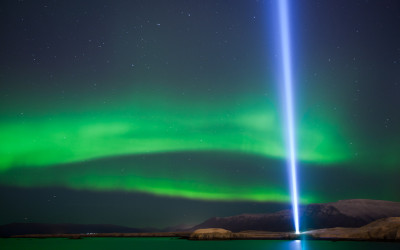
Monday’s Monument: Imagine Peace Tower, Viðey Island, Iceland
The Imagine Peace Tower is a memorial to John Lennon from his widow, Yoko Ono, located on Viðey Island in Kollafjörður Bay near Reykjavík, Iceland. It consists of a tall tower of light, projected from a white stone monument that has the words "Imagine Peace" carved...
read more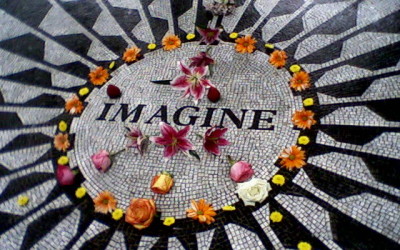
Monday’s Monument: Strawberry Fields, Central Park, New York
It's interesting, isn't it, how much the late Beatle and peace activist John Lennon has become an international symbol of peace. Near Central Park West, between 71st and 74th Streets, is Strawberry Fields, 2.5 acres in Central Park that pays tribute to Lennon. John...
read more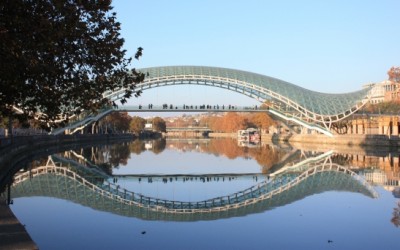
Monday’s Monument: Bridge of Peace, Tbilisi, Georgia
The 490 foot-long bow-shaped pedestrian bridge spans the Mtkvari River in Tbilisi, capital of Georgia. Dedicated in 2010, it connects Old Tbilisi with the new district. The curvy steel and glass canopy top shimmers with an interactive light display at night, generated...
read more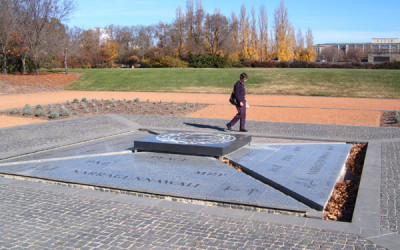
Monday’s Monument: Peace Park, Canberra, Australia
The Canberra Peace Park is beside Lake Burley Griffin between the lake and the National Library of Australia, in Canberra, the national capital of Australia. It was built in 1986, the United Nations Year of Peace. The central zone contains a square granite plinth with...
read more
If you
haven’t read
this book,
you should!
Ten Questions to Ask at a Historic Site
In his book Lies Across America, Professor James Loewen posed these ten questions to ask at a historic site.
1. When did this location become a historic site? (When was the marker or monument put up? Or the house interpreted?) How did that time differ from ours? From the time of the event or person interpreted?
2. Who sponsored it? representing which participant groups’s point of view? What was their position in the social structure when the event occurred? When the site went “up”?
3. What were the sponsor’s motives? What were their ideological needs and social purposes? What were their values?
4. What is the intended audience for the site? What values were they trying to leave for us, today? What does the site ask us to go and do or think about?
5. Did the sponsors have government support? At what level? Who was ruling the government at the time? What ideological arguments were used to get the government acquiescence?
6. Who is left out? What points of view go largely unheard? How would the story differ if a different group told it? Another political party? Race? Sex? Class? Religious group?
7. Are there problematic (insulting, degrading) words or symbols that would not be used today, or by other groups?
8. How is the site used today? Do traditional rituals continue to connect today’s public to it? Or is it ignored? Why?
9. Is the presentation accurate? What actually happened? What historical sources tell of the event, people, or period commemorated at this site?
10. How does the site fit in with others that treat the same era? Or subject? What other people lived ad events happened then but are not commemorated? Why?
Travel across the United States in a 1965 Airstream Trailer as filmmaker Tom Trinley visits historic sites and monuments unveiling the many sides of history not told on the landscape or in history books. On-camera appearances by Howard Zinn, James Loewen, Lonnie Bunch and Adam “Fortunate Eagle” Nordwall. Inspired by “Lies My Teacher Told Me” and “A Peoples’ History of the United States.”
At the Un-National Monument along the Canadian Border
By William E. Stafford
This is the field where the battle did not happen,
where the unknown soldier did not die.
This is the field where grass joined hands,
where no monument stands,
and the only heroic thing is the sky.
Birds fly here without any sound,
unfolding their wings across the open.
No people killed—or were killed—on this ground
hallowed by neglect and an air so tame
that people celebrate it by forgetting its name.
Of princes, shall outlive this powerful rhyme;
But you shall shine more bright in these contents
Than unswept stone besmear’d with sluttish time.
When wasteful war shall statues overturn,
And broils root out the work of masonry,
Nor Mars his sword nor war’s quick fire shall burn
The living record of your memory.
–William Shakespeare, from Sonnet 55

Listen to this song!
And we find it really hard to say we’re sorry
So the shadow of injustice still remains
We build monuments to those who died in battle
But we seldom speak of those who died in chains