
Request the Monuments Database
The weekly “Monday’s Monument” feature on this website is being fed from a database we are compiling that currently contains 200+ monuments. If you’d like a copy of the database, drop us a line.
Peace & Justice Monuments
Since May, 2015, every Monday morning the peaceCENTER has been posting a little essay about a peace or social justice monument. For more than a decade, ever since the peaceCENTER was contracted by a national peace & human rights group to develop a workshop exploring strategies for creating memorials about acts of violence and injustice that did not glorify the bloodshed, we have pondered the relationship between the landscape and civic memory.
“I would rather take care of the stomachs of the living than the glory of the departed in the form of monuments.”
Alfred Nobel
As we showcase these monuments we hope you will join us in this exploration. For now, we’re concentrating on publicly accessible outdoor works (indoor art, museums and historic sites may come later . . . ) Some are grassroots and homespun; others, more complicated in their funding and execution. They all have a story to tell and we can learn from all of them.
MONDAY’S MONUMENT
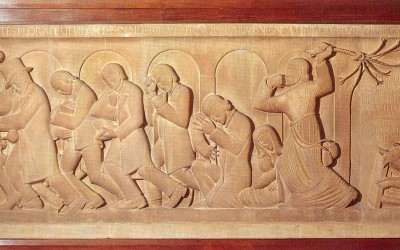
Monday’s Monument: War Memorial Frieze, Leeds, England
Oh, the irony! After World War I, the University of Leeds commissioned the radical sculptor (and type designer) Eric Gill to produce a war memorial. In 1923 he presented a frieze of the gospel story of Jesus driving the money-changers out of the temple. Those...
read more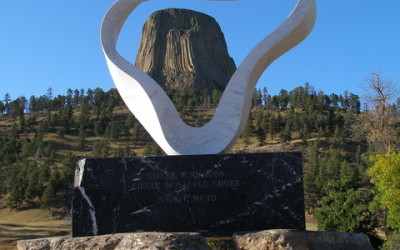
Monday’s Monument: Circle of Sacred Smoke, Devils Tower, Wyoming
Dedicated in 2008, Junkyu Muto's 12-foot-high "Circle of Sacred Smoke," the third of seven sculptures he plans to carve to promote world peace, represents the first circle of smoke ascending from a peace pipe, Muto said. The peace pipe has spiritual meaning for Native...
read more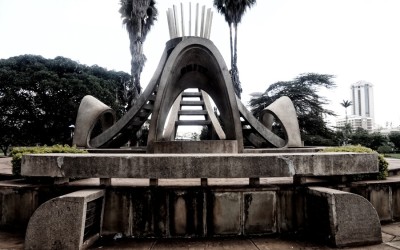
Monday’s Monument: Peace, Love and Unity, Nairobi, Kenya
Or, as they say in Kiswahili, Amani, Upendo And Umoja. This fountain is in the 76-acre Uhuhru (Freedom) Park in central Nairobi, which was established by Jomo Kenyatta, the first president of Kenya. It was here that a crowd of more than 40,000 gathered to watch the...
read more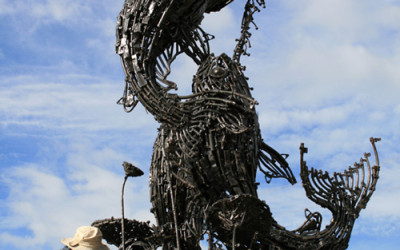
Monday’s Monument: World of Peace, Kampong Thom, Cambodia
In 2003, working out of a workshop in Cambodia’s capital, Phnom Penh, Mark Solomon, an American blacksmith and anti-gun campaigner, taught basic metalwork and safety skills to artists from Cambodia’s Royal University of Fine Arts. As part of The Peace Art Project...
read more![Monday’s Monument: Reichs[anti]kolonialehrendenkmal, Bremen, Germany](http://www.sanantoniopeace.center/wp-content/uploads/2015/12/humanityagainstapartheidbremengermany-375x250.jpg)
Monday’s Monument: Reichs[anti]kolonialehrendenkmal, Bremen, Germany
This ten-meter high structure was completed in 1931 as a monument to the German colonies which then included Cameroon, Togo, Deutsch-Ostafrika [Tanzania], Deutsch-Südwestafrika [Namibia] and several islands. For decades the “Reichskolonialehrendenkmal” stood as a...
read more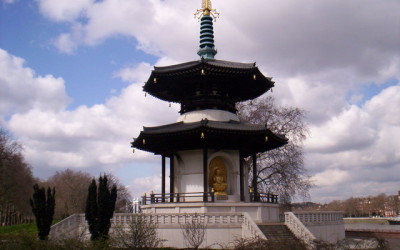
Monday’s Monument: Peace Pagoda, Battersea Park, London, England
The Founder and Preceptor of Nipponzan Myohoji Buddhist Order, The Most Venerable Nichidatsu Fujii (1885 – 1985), or Fujii Guruji as he was called by Mahatma Gandhi, was devoted to world pacifism and international disarmament. He worked with Gandhi in India in the...
read more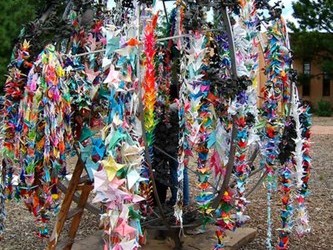
Monday’s Monument: Children’s Peace Statue, Albuquerque, NM
This statue was dedicated at the Balloon Museum August 4, 2013. The Children’s Peace Statue is a monument designed and funded entirely by children. In the fall of 1989, children of Arroyo del Oso Elementary School in Albuquerque, New Mexico were studying the Arms...
read more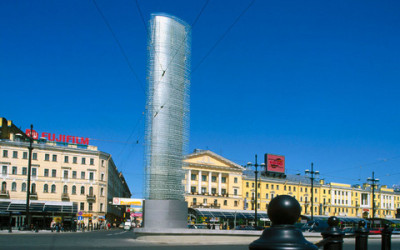
Monday’s Monument: Peace Tower, St. Petersburg, Russia
Built for the 300th anniversary of the founding of St. Petersburg in 2003, France financed construction of this 59.4-foot "Peace Tower" — a transparent column with the word peace written in many languages and signatures on the base left by all the world leaders coming...
read more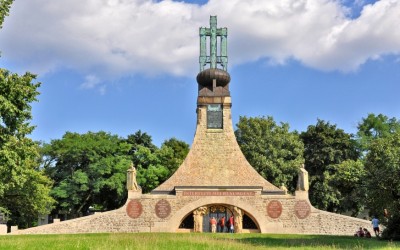
Monday’s Monument: Mohyla Âru, Prace Village, Czech Republic
The Cairn of Peace was built to honor the victims of Napoleon’s victorious battle over the Austrians and Russians near Austerlitz, fought on December 2, 1805. It was the initiative of a priest, A. Slovák, to create a pious "place of light" from the center of a...
read more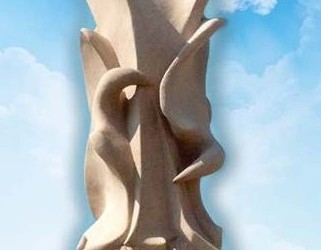
Monday’s Monument: Path of Peace Statue, Des Moines, Iowa
The Path of Peace sculpture, depicting three doves, is an original work of art by Ron Dinsdale and crafted from Indiana Bedford limestone. It is a joint project of Des Moines Area Community College and Iowa Peacemakers Monument, Inc. and was dedicated in September...
read more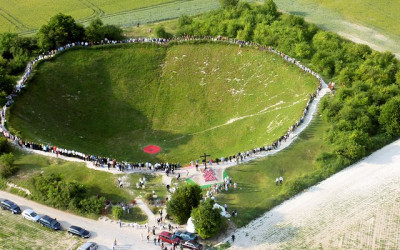
Monday’s Monument: The Lochnagar Crater, La Boisselle, France
On 1st July 1916, the first day of the Battle of the Somme at La Boisselle, near Albert, France, the British Royal Engineers dug a mine and detonated 27 tons of high explosive to tunnel towards and under the German trenches and explode mines under them. A massive...
read more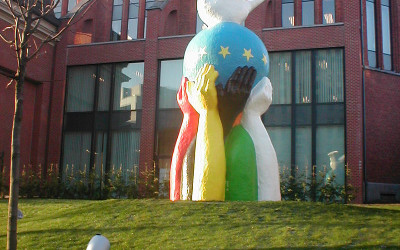
Monday’s Monument: Unity in Peace, Brussels, Belgium
The Statue of Europe (also referred to as Unity in Peace) is a sculpture symbolizing peace through European integration,demonstrating the motto of the European Union (EU), United in Diversity. It is located in the garden of Convent Van Maerlant , the library of the...
read more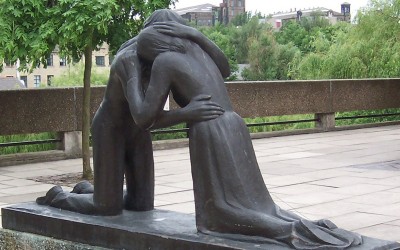
Monday’s Monument: Reconciliation, Bradford, England
The sculpture Reconciliation is on permanent display in the square outside the J.B. Priestley Library, at Bradford University. It shows two exhausted figures, a male and a female, kneeling and embracing. The sculptor, Josefina de Vasconcellos, was inspired by the...
read more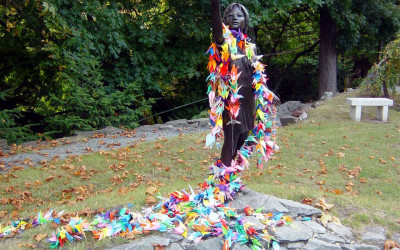
Monday’s Monument: Peace Park, Seattle, WA
Peace Park was the dream of Dr. Floyd Schmoe, who after winning the Hiroshima Peace Prize in 1998, used the $5,000 prize money to clear a small lot near the University of Washington. From a pile of wrecked cars, garbage, and brush, he worked with community volunteers...
read more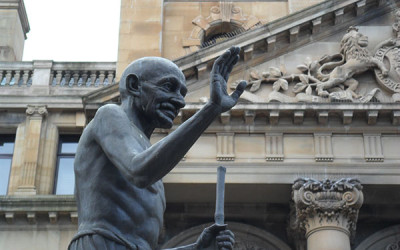
Monday’s Monument: Gandhi Statue, Pietermaritzburg, South Africa
The events of the night of 7 June 1893 changed the course of Mahatma Gandhi's life. The young Indian lawyer had come to South Africa for work. He was traveling from Durban to Johannesburg and had a first class ticket for the train. He was told to leave the European...
read more
If you
haven’t read
this book,
you should!
Ten Questions to Ask at a Historic Site
In his book Lies Across America, Professor James Loewen posed these ten questions to ask at a historic site.
1. When did this location become a historic site? (When was the marker or monument put up? Or the house interpreted?) How did that time differ from ours? From the time of the event or person interpreted?
2. Who sponsored it? representing which participant groups’s point of view? What was their position in the social structure when the event occurred? When the site went “up”?
3. What were the sponsor’s motives? What were their ideological needs and social purposes? What were their values?
4. What is the intended audience for the site? What values were they trying to leave for us, today? What does the site ask us to go and do or think about?
5. Did the sponsors have government support? At what level? Who was ruling the government at the time? What ideological arguments were used to get the government acquiescence?
6. Who is left out? What points of view go largely unheard? How would the story differ if a different group told it? Another political party? Race? Sex? Class? Religious group?
7. Are there problematic (insulting, degrading) words or symbols that would not be used today, or by other groups?
8. How is the site used today? Do traditional rituals continue to connect today’s public to it? Or is it ignored? Why?
9. Is the presentation accurate? What actually happened? What historical sources tell of the event, people, or period commemorated at this site?
10. How does the site fit in with others that treat the same era? Or subject? What other people lived ad events happened then but are not commemorated? Why?
Travel across the United States in a 1965 Airstream Trailer as filmmaker Tom Trinley visits historic sites and monuments unveiling the many sides of history not told on the landscape or in history books. On-camera appearances by Howard Zinn, James Loewen, Lonnie Bunch and Adam “Fortunate Eagle” Nordwall. Inspired by “Lies My Teacher Told Me” and “A Peoples’ History of the United States.”
At the Un-National Monument along the Canadian Border
By William E. Stafford
This is the field where the battle did not happen,
where the unknown soldier did not die.
This is the field where grass joined hands,
where no monument stands,
and the only heroic thing is the sky.
Birds fly here without any sound,
unfolding their wings across the open.
No people killed—or were killed—on this ground
hallowed by neglect and an air so tame
that people celebrate it by forgetting its name.
Of princes, shall outlive this powerful rhyme;
But you shall shine more bright in these contents
Than unswept stone besmear’d with sluttish time.
When wasteful war shall statues overturn,
And broils root out the work of masonry,
Nor Mars his sword nor war’s quick fire shall burn
The living record of your memory.
–William Shakespeare, from Sonnet 55

Listen to this song!
And we find it really hard to say we’re sorry
So the shadow of injustice still remains
We build monuments to those who died in battle
But we seldom speak of those who died in chains