
Request the Monuments Database
The weekly “Monday’s Monument” feature on this website is being fed from a database we are compiling that currently contains 200+ monuments. If you’d like a copy of the database, drop us a line.
Peace & Justice Monuments
Since May, 2015, every Monday morning the peaceCENTER has been posting a little essay about a peace or social justice monument. For more than a decade, ever since the peaceCENTER was contracted by a national peace & human rights group to develop a workshop exploring strategies for creating memorials about acts of violence and injustice that did not glorify the bloodshed, we have pondered the relationship between the landscape and civic memory.
“I would rather take care of the stomachs of the living than the glory of the departed in the form of monuments.”
Alfred Nobel
As we showcase these monuments we hope you will join us in this exploration. For now, we’re concentrating on publicly accessible outdoor works (indoor art, museums and historic sites may come later . . . ) Some are grassroots and homespun; others, more complicated in their funding and execution. They all have a story to tell and we can learn from all of them.
MONDAY’S MONUMENT
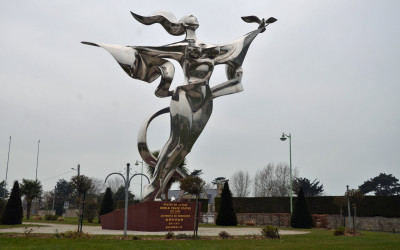
Monday’s Monument: World Peace Statue, Grandcamp-Maisy, Normandy, France
Yao Yuan is a Chinese sculptor who was sentenced to work in a factory during the Cultural Revolution and later devoted his life and work to world peace. He created a Statue of Peace for Korea in 1995, one for Russia in 2000 and, in 2011 a stainless-steel World Peace...
read more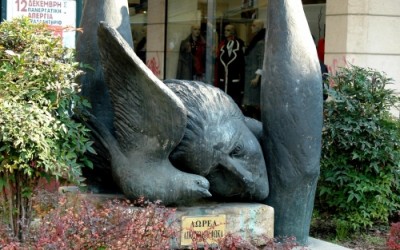
Monday’s Monument: Grigoris Lambrakis Statue, Thessaloniki, Greece
On May 22, 1963, right-wing forces ran down and killed Grigoris Lambrakis, a leftist member of the Greek Parliament, who had been speaking at a peace meeting. Vassilis Vassilikos based his novel Z on Lambrakis's death; Costa-Gavras then adapted the novel for his film...
read more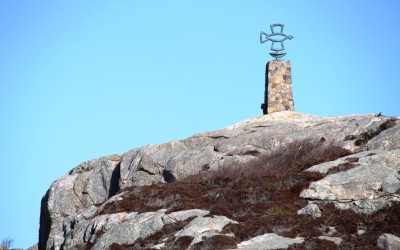
Monday’s Monument: Pax-Stein, Lindesnes, Norway
On 21 October 1942, the Palatea, a German ship carrying prisoners of war destined for slave labor camps in occupied Norway, was torpedoed off Lindesnes lighthouse. 915 Russian prisoners & 71 German crew perished. The wreck was located in 1997 by the Royal Norwegian...
read more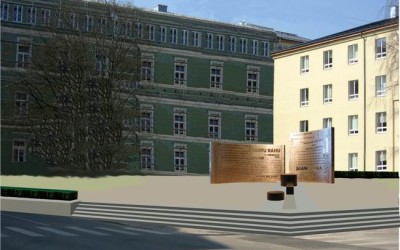
Monday’s Monument: Tartu Rahu, Tartu, Estonia
On the second of February of 1920 Jaan Poska, Ants Piip, Mait Püüman, Julius Seljamaa, and Jaan Soots sat down with their Russian counterparts Adolf Joffe and Isidor Gukovsky and signed the Treaty of Tartu, also known as the Tartu Peace Treaty, or Tartu Rahu in...
read more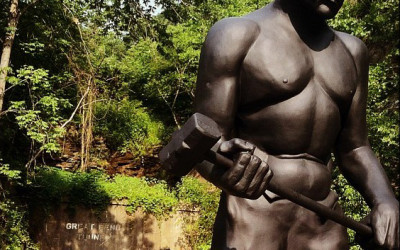
Monday’s Monument: John Henry, Talcott, WV
The legend of John Henry, the “steel-drivin' man” who beat the newfangled steel drill in a contest of strength and then died from exhaustion, is probably based on a real person, claimed by West Virginia as happening at the Great Bend Tunnel of the C&O Railroad....
read more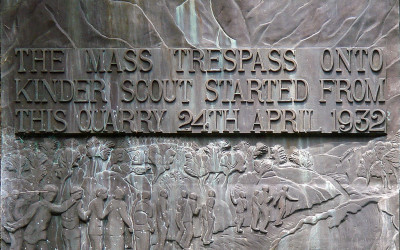
Monday’s Monument: Kinder Mass Trespass Plaque, near Hayfield, England
The Kinder Mass Trespass was an act of civil disobedience by young men from Manchester and Sheffield intended to secure free access to England's mountains and moorlands. The ramblers walked from Bowden Bridge Quarry to climb the hill called Kinder Scout in the...
read more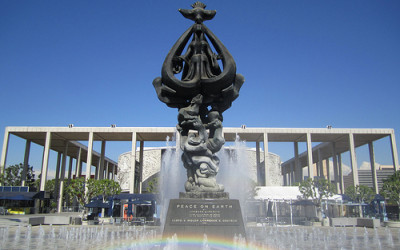
Monday’s Monument: Peace on Earth, Los Angeles, CA
This sculpture, which portrays a dove descending to earth with the spirit of peace, symbolized by the Madonna standing inside a tear shaped canopy, supported by a base of reclining lambs was designed by cubist Jacques Lipchitz. It is in the plaza between the...
read more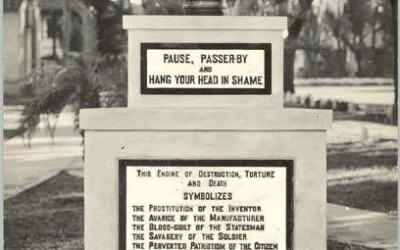
Monday’s Monument: Peace Memorial, Rollins College, Winter Park, FL
This monument, featuring a German artillery shell, was erected on the grounds of Rollins College on November 11, 1938. In March of the next year Rollins hosted a world peace conference (along with the Church Peace Union and the World Alliance for International...
read more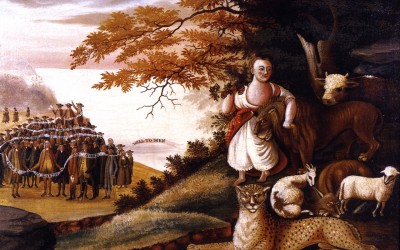
Monday’s Monument: Edward Hicks House, Newtown, PA
Edwards Hicks was a Quaker sign painter, best known today for his "ornamental" paintings, " especially the motif known as "The Peaceable Kingdom," which illuminates Isaiah 11: "The wolf also shall dwell with the lamb, and the leopard shall lie down with the kid, and...
read more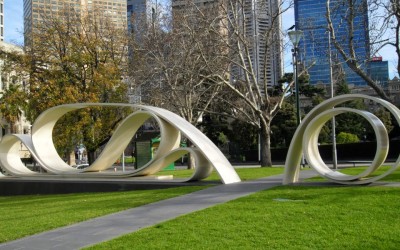
Monday’s Monument: Great Petition, Melbourne, Australia
When suffragists campaigned for the vote in Australia in the late nineteenth century, critics said that women had no interest in political rights. Activists sought support from both men and women throughout Victoria. A giant petition with 30,000 signatures , later to...
read more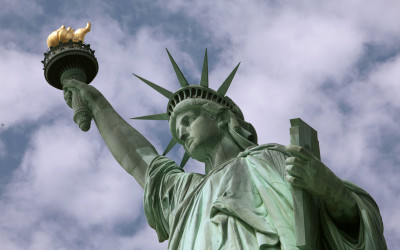
Monday’s Monument: The Statue of Liberty, New York, NY
The Statue of Liberty (Liberty Enlightening the World) is a colossal neoclassical sculpture on Liberty Island in New York Harbor. The copper statue, designed by Frédéric Auguste Bartholdi, was built by Gustave Eiffel and dedicated on October 28, 1886. It was a gift to...
read more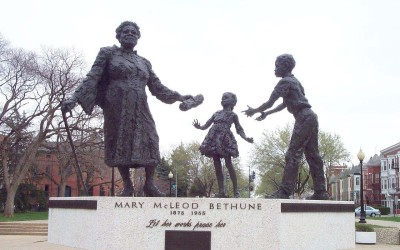
Monday’s Monument: Mary McLeod Bethune Memorial, Washington, D.C.
The Mary McLeod Bethune Memorial was the first statue erected on public land in Washington, D.C. to honor an African American and a woman. It is located in Lincoln Park, at East Capitol Street and 12th Street N.E. The statue features an elderly Mrs. Bethune handing a...
read more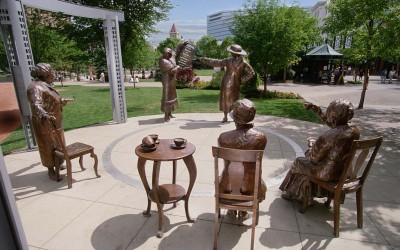
Monday’s Monument: Women are Persons!, Calgary, Alberta, Canada
For International Woman's Day we thought we'd highlight a few monuments honoring women this month. Five Alberta women fought to have Canadian women recognized constitutionally as "persons" who were eligible to be named to the Senate. Emily Murphy led the battle and...
read more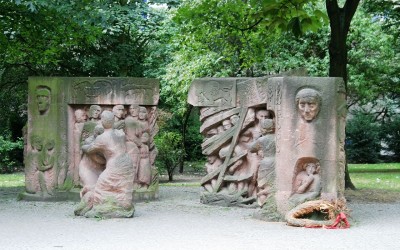
Monday’s Monument: Block der Frauen, Berlin, Germany
The Rosenstraße nonviolent protest, on "Rose street" in Berlin, was carried out by the non-Jewish wives and relatives of Jewish men who had been arrested and locked up in a provisional collecting center rather than being shipped to the death camp at Auschwitz like the...
read more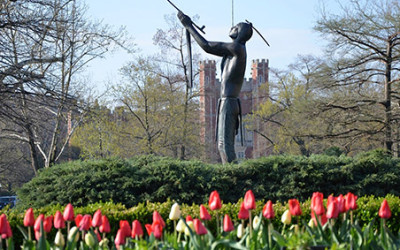
Monday’s Monument: May We Have Peace, Norman, Oklahoma
The sculpture was erected in 1992 through the efforts of the Oklahoma University Student Association at a main north entrance to the University of Oklahoma campus. A standing Native-American male figure faces east. He wears moccasins, buckskin pants and a breechcloth....
read more
If you
haven’t read
this book,
you should!
Ten Questions to Ask at a Historic Site
In his book Lies Across America, Professor James Loewen posed these ten questions to ask at a historic site.
1. When did this location become a historic site? (When was the marker or monument put up? Or the house interpreted?) How did that time differ from ours? From the time of the event or person interpreted?
2. Who sponsored it? representing which participant groups’s point of view? What was their position in the social structure when the event occurred? When the site went “up”?
3. What were the sponsor’s motives? What were their ideological needs and social purposes? What were their values?
4. What is the intended audience for the site? What values were they trying to leave for us, today? What does the site ask us to go and do or think about?
5. Did the sponsors have government support? At what level? Who was ruling the government at the time? What ideological arguments were used to get the government acquiescence?
6. Who is left out? What points of view go largely unheard? How would the story differ if a different group told it? Another political party? Race? Sex? Class? Religious group?
7. Are there problematic (insulting, degrading) words or symbols that would not be used today, or by other groups?
8. How is the site used today? Do traditional rituals continue to connect today’s public to it? Or is it ignored? Why?
9. Is the presentation accurate? What actually happened? What historical sources tell of the event, people, or period commemorated at this site?
10. How does the site fit in with others that treat the same era? Or subject? What other people lived ad events happened then but are not commemorated? Why?
Travel across the United States in a 1965 Airstream Trailer as filmmaker Tom Trinley visits historic sites and monuments unveiling the many sides of history not told on the landscape or in history books. On-camera appearances by Howard Zinn, James Loewen, Lonnie Bunch and Adam “Fortunate Eagle” Nordwall. Inspired by “Lies My Teacher Told Me” and “A Peoples’ History of the United States.”
At the Un-National Monument along the Canadian Border
By William E. Stafford
This is the field where the battle did not happen,
where the unknown soldier did not die.
This is the field where grass joined hands,
where no monument stands,
and the only heroic thing is the sky.
Birds fly here without any sound,
unfolding their wings across the open.
No people killed—or were killed—on this ground
hallowed by neglect and an air so tame
that people celebrate it by forgetting its name.
Of princes, shall outlive this powerful rhyme;
But you shall shine more bright in these contents
Than unswept stone besmear’d with sluttish time.
When wasteful war shall statues overturn,
And broils root out the work of masonry,
Nor Mars his sword nor war’s quick fire shall burn
The living record of your memory.
–William Shakespeare, from Sonnet 55

Listen to this song!
And we find it really hard to say we’re sorry
So the shadow of injustice still remains
We build monuments to those who died in battle
But we seldom speak of those who died in chains