
Request the Monuments Database
The weekly “Monday’s Monument” feature on this website is being fed from a database we are compiling that currently contains 200+ monuments. If you’d like a copy of the database, drop us a line.
Peace & Justice Monuments
Since May, 2015, every Monday morning the peaceCENTER has been posting a little essay about a peace or social justice monument. For more than a decade, ever since the peaceCENTER was contracted by a national peace & human rights group to develop a workshop exploring strategies for creating memorials about acts of violence and injustice that did not glorify the bloodshed, we have pondered the relationship between the landscape and civic memory.
“I would rather take care of the stomachs of the living than the glory of the departed in the form of monuments.”
Alfred Nobel
As we showcase these monuments we hope you will join us in this exploration. For now, we’re concentrating on publicly accessible outdoor works (indoor art, museums and historic sites may come later . . . ) Some are grassroots and homespun; others, more complicated in their funding and execution. They all have a story to tell and we can learn from all of them.
MONDAY’S MONUMENT
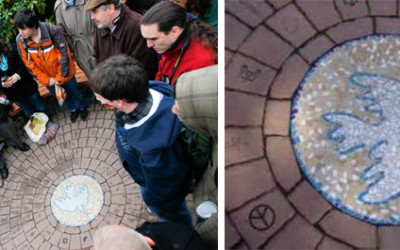
Monday’s Monument: Brandeis Peace Monument, Waltham, MA
Building for Peace was a recognized club of the Brandeis Student Union whose mission was to construct a peace monument on campus that would serve as a physical testament to the universality of peace and the diversity at the university. The club was comprised of the...
read more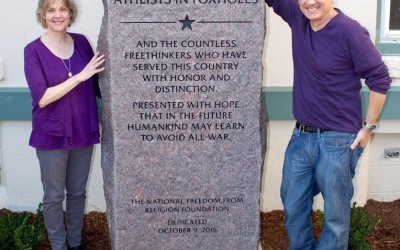
Monday’s Monument: Atheists in the Foxholes, Madison, WI
A new monument in Madison, Wisconsin contradicts an old jingoistic slogan that proclaims no secular person could, or would, give their lives on the battlefield in the name of the United States. The old aphorism “There are no atheists in foxholes,” has served to spark...
read more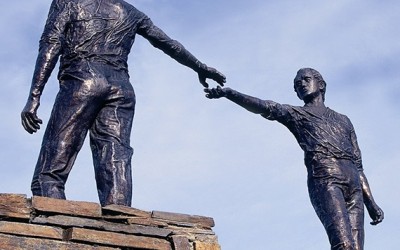
Monday’s Monument: Reconciliation/Hands Across the Divide, Derry City, Northern Ireland
As you enter the city across Craigavon Bridge, the first thing you see is the Hands Across the Divide monument. This striking bronze sculpture by Maurice Harron of two men reaching out to each other symbolizes the spirit of reconciliation and hope for the future; it...
read more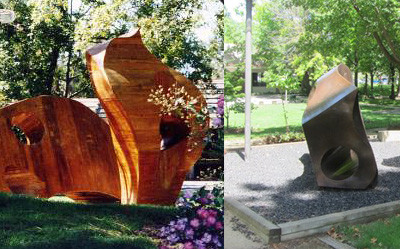
Monday’s Monument: Peace Sculpture, Livermore, CA
The Lawrence Livermore Laboratory was established in 1952 at the height of the Cold War to meet urgent national security needs by advancing nuclear weapons science and technology. In 1982 a chemist named Leon Smith was dying of cancer and wrote a letter to the editor...
read more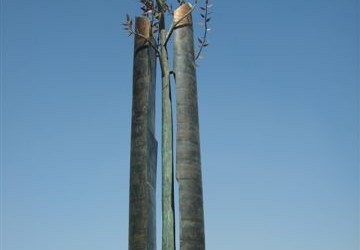
Monday’s Monument: Tolerance Monument, Jerusalem, Israel
The gift of a Polish billionaire in 2008, the Tolerance Monument is an outdoor sculpture located in a park near Goldman Promenade in Jerusalem. Etched on a stone at the entrance to the park are the following words: "The monument is in the form of two halves of a...
read more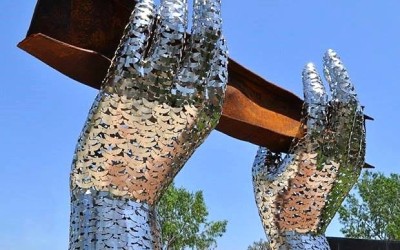
Monday’s Monument: Reflect, Rosemead, California
Is this a peace monument? You decide. The sculpture consists of an iron beam pulled from the rubble of the World Trade Center held up by two stainless steel hands. The hands holding it up are constructed from 2,976 individually crafted stainless steel birds, each...
read more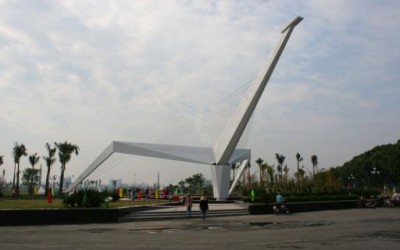
Monday’s Monument: Peace Bird Gate, Hanoi, Vietnam
The Peace Bird Gate at Peace Park in Hanoi celebrates Hanoi's Millennium. Inaugurated by the Hanoi's People Committee for the celebration on October 8, 2010, the structure resembles the traditional Vietnamese bird, the Lac Viet bird. Hanoi was recognized in 1999 as a...
read more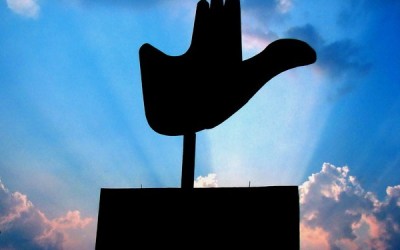
Monday’s Monument: Open Hand, Chandigarh, India
After the partition of India on 15 August, 1947, the former British province of Punjab was also split between east Punjab in India and west Punjab in Pakistan. The Indian Punjab required a new capital city to replace Lahore, which became part of Pakistan during the...
read more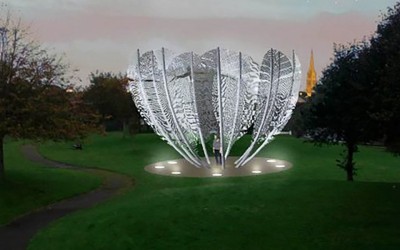
Monday’s Monument: Kindred Spirits, County Cork, Ireland
Sixteen years after the Choctaw and other "civilized" tribes had endured the Trail of Tears and been forcefully relocated to Oklahoma, the great potato famine of was spreading in Ireland. While numerous crops were grown in great quantity in Ireland, Britain had...
read more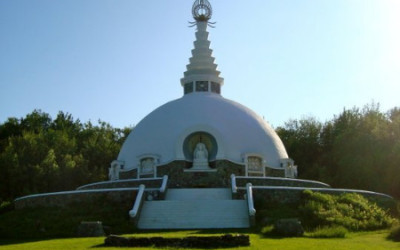
Monday’s Monument: Grafton Peace Pagoda, Grafton, NY
In 1978, Native Americans organized “The Longest Walk”: participants walked cross-country from San Francisco to Washington, DC. Accompanying them on their walk was a Japanese Buddhist Nun from the Nipponzan Myohoji order. Since then, Jun Yasuda has crossed the country...
read more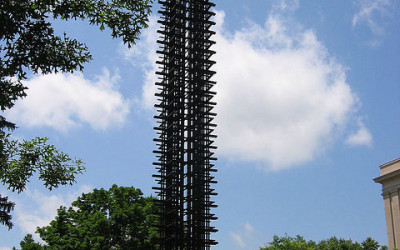
Monday’s Monument: Fulbright Peace Fountain, Fayetteville, AK
Fulbright College of Arts and Sciences at the University of Arkansas dedicated the peace fountain in 1998 in tribute to the legacy of the late Senator J. William Fulbright. Fulbright believed that education, particularly study abroad, has the power to promote...
read more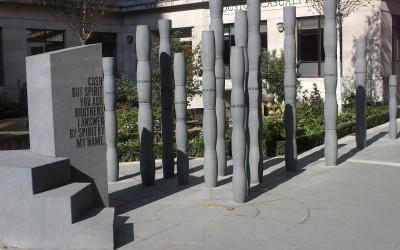
Monday’s Monument: The Gilt of Cain, City of London
This powerful sculpture commemorates the abolition of the transatlantic slave trade in 1807, which began the process of the emancipation of slaves throughout the British Empire. Fen Court in the City of London is the site of a churchyard with a strong historical...
read more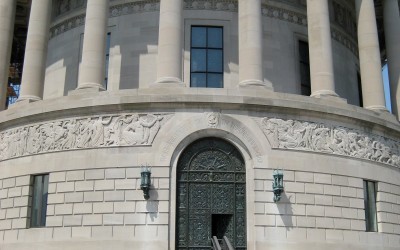
Monday’s Monument: The Triumphs of Peace Endure, Elks Veterans Memorial, Chicago, IL
This Beaux Arts-style domed building, which also serves as the Elk's headquarters, was built in 1926. The two friezes, composed of more than seventy figures carved in low relief, are just above a legend in Gothic script that reads The Triumphs of Peace Endure—The...
read more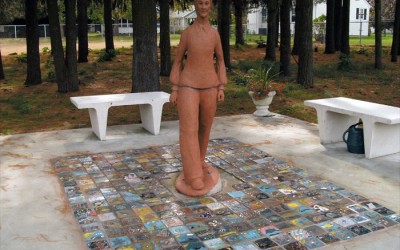
Monday’s Monument: Peace Pilgrim Park, Egg Harbor, NJ
In Peace Pilgrim Park you will find a serpentine waterway, a peace pole, a butterfly garden, a gazebo, picnic benches, memorial plaque/stone, and a few acres of grass to wonder around and explore. This park is maintained by the Friends of Peace Pilgrim in her memory....
read more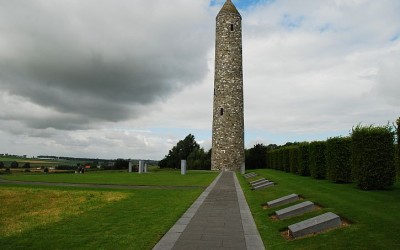
Monday’s Monument: Island of Ireland Peace Park, Mesen, Flanders, Belgium
During World War I, the Irish — unionists and nationalists, Protestants and Catholics — fought side-by-side in the trenches as part of the British forces Here in Messines, site of a 1917 battle, the Irish not only look back to memorialize those who died in that war,...
read more
If you
haven’t read
this book,
you should!
Ten Questions to Ask at a Historic Site
In his book Lies Across America, Professor James Loewen posed these ten questions to ask at a historic site.
1. When did this location become a historic site? (When was the marker or monument put up? Or the house interpreted?) How did that time differ from ours? From the time of the event or person interpreted?
2. Who sponsored it? representing which participant groups’s point of view? What was their position in the social structure when the event occurred? When the site went “up”?
3. What were the sponsor’s motives? What were their ideological needs and social purposes? What were their values?
4. What is the intended audience for the site? What values were they trying to leave for us, today? What does the site ask us to go and do or think about?
5. Did the sponsors have government support? At what level? Who was ruling the government at the time? What ideological arguments were used to get the government acquiescence?
6. Who is left out? What points of view go largely unheard? How would the story differ if a different group told it? Another political party? Race? Sex? Class? Religious group?
7. Are there problematic (insulting, degrading) words or symbols that would not be used today, or by other groups?
8. How is the site used today? Do traditional rituals continue to connect today’s public to it? Or is it ignored? Why?
9. Is the presentation accurate? What actually happened? What historical sources tell of the event, people, or period commemorated at this site?
10. How does the site fit in with others that treat the same era? Or subject? What other people lived ad events happened then but are not commemorated? Why?
Travel across the United States in a 1965 Airstream Trailer as filmmaker Tom Trinley visits historic sites and monuments unveiling the many sides of history not told on the landscape or in history books. On-camera appearances by Howard Zinn, James Loewen, Lonnie Bunch and Adam “Fortunate Eagle” Nordwall. Inspired by “Lies My Teacher Told Me” and “A Peoples’ History of the United States.”
At the Un-National Monument along the Canadian Border
By William E. Stafford
This is the field where the battle did not happen,
where the unknown soldier did not die.
This is the field where grass joined hands,
where no monument stands,
and the only heroic thing is the sky.
Birds fly here without any sound,
unfolding their wings across the open.
No people killed—or were killed—on this ground
hallowed by neglect and an air so tame
that people celebrate it by forgetting its name.
Of princes, shall outlive this powerful rhyme;
But you shall shine more bright in these contents
Than unswept stone besmear’d with sluttish time.
When wasteful war shall statues overturn,
And broils root out the work of masonry,
Nor Mars his sword nor war’s quick fire shall burn
The living record of your memory.
–William Shakespeare, from Sonnet 55

Listen to this song!
And we find it really hard to say we’re sorry
So the shadow of injustice still remains
We build monuments to those who died in battle
But we seldom speak of those who died in chains