
Request the Monuments Database
The weekly “Monday’s Monument” feature on this website is being fed from a database we are compiling that currently contains 200+ monuments. If you’d like a copy of the database, drop us a line.
Peace & Justice Monuments
Since May, 2015, every Monday morning the peaceCENTER has been posting a little essay about a peace or social justice monument. For more than a decade, ever since the peaceCENTER was contracted by a national peace & human rights group to develop a workshop exploring strategies for creating memorials about acts of violence and injustice that did not glorify the bloodshed, we have pondered the relationship between the landscape and civic memory.
“I would rather take care of the stomachs of the living than the glory of the departed in the form of monuments.”
Alfred Nobel
As we showcase these monuments we hope you will join us in this exploration. For now, we’re concentrating on publicly accessible outdoor works (indoor art, museums and historic sites may come later . . . ) Some are grassroots and homespun; others, more complicated in their funding and execution. They all have a story to tell and we can learn from all of them.
MONDAY’S MONUMENT
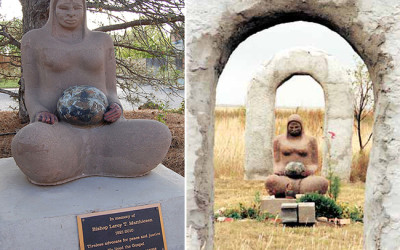
Monday’s Monument: Madre del Mundo Statue, Amarillo, TX
The Madre del Mundo Statue was created by artist/potter/sculptor Marsha Gomez; she designed the Madre to be inclusive of all women, so each could see herself in the image, whether African-American, Asian, American Indian, Hispanic or white. Many see the image as Mary;...
read more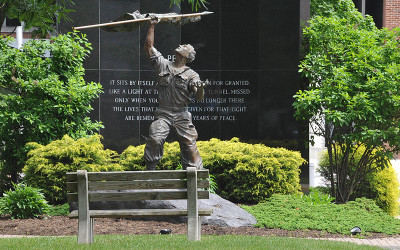
Monday’s Monument: People of Peace, Woodbury, NJ
Standing outside the Gloucester County Courthouse, the bronze statue of an unarmed soldier holds aloft an American flag. Commissioned by the county's veteran's commission, it was sculpted by Deptford, NJ artist Frank A. Seder Jr., who said he hoped his piece would...
read more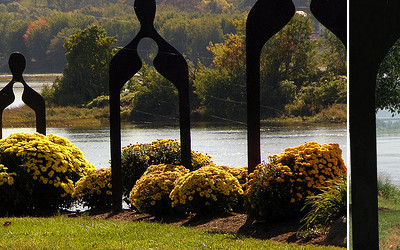
Monday’s Monument: Peace Garden, Harrisburg, PA
Founded in 1993, the Peace Garden, situated along the Susquehanna River in the two blocks just north of the Pennsylvania Governor’s Residence, is a collaboration between the city of Harrisburg and the Harrisburg-Hershey chapter of Physicians for Social Responsibility....
read more
Monday’s Monument: Peace Doves, La Paz, Mexico
Palomas de la Paz is known by the locals as "La Cola de la Ballena," because, although it represents two dove in profile, also bears the shape of a whale's tale, in honor of the many species of whale that populate the Sea of Cortez, as well as the California Gray...
read more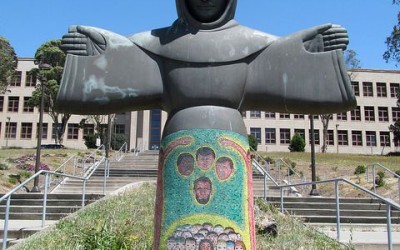
Monday’s Monument: St. Francis of the Guns, 1968, San Francisco
After the 1968 shootings of Bobby Kennedy and Martin Luther King Jr, San Francisco Mayor Joseph Alioto led a voluntary gun turn-in program that accumulated a symbolic 1,968 weapons. Beniamino Bufano, a Bay Area artist, was asked to sculpt something with the melted gun...
read more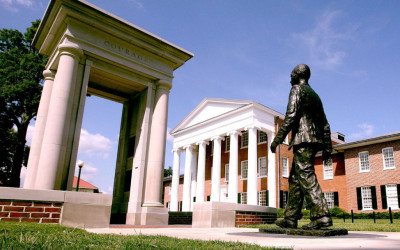
Monday’s Monument: James Meredith Statue, Ol’ Miss, Oxford, Mississippi
The James Meredith monument was dedicated in 2006 a symbol of racial reconciliation for a state that continues to struggle with how to move forward from a violently racist past. It commemorates the 1962 enrollment of James Meredith at Ol' Miss, forced by Federal...
read more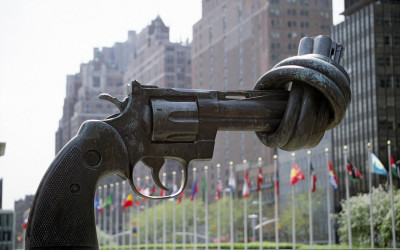
Monday’s Monument: Knotted Gun, NYC
"Non-Violence" is a bronze sculpture by Swedish artist Carl Fredrik Reuterswärd of an over-sized Colt Python .357 Magnum revolver with a knotted barrel and the muzzle pointing upwards. Carl made this sculpture after singer, songwriter and peace activist John Lennon...
read more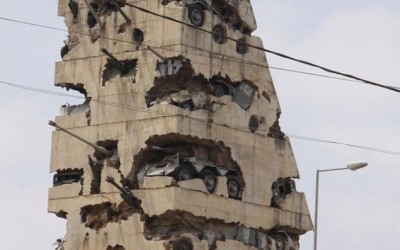
Monday’s Monument: Hope for Peace, Beirut, Lebanon
When this statue was unveiled in 1995, the UK Independent called it a "tank sandwich." The 5,000 ton pyramid was designed by Armand Fernandez, who tried to peddle the concept to the city of Strasbourg, France during D-Day celebrations in the early 1970s and then to...
read more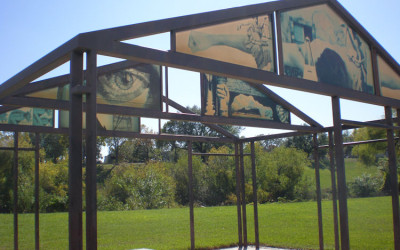
Monday’s Monument: Passage Inachevé / Incomplete Passage, Houston, Texas
This skeletal house was installed Buffalo Bayou in 1990 in commemoration of the French Bicentennial. The images embedded in the gables abstractly reflect issues of human rights, freedom of expressions, contemplative ideas, elements of history and contemporary concerns.
read more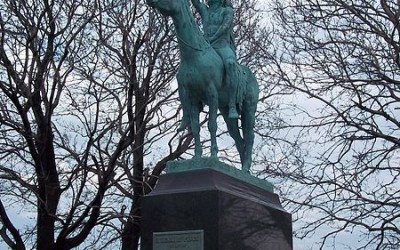
Monday’s Monument: Signal of Peace, Chicago
When Buffalo Bill’s Wild West Show came to Paris to perform, Utah sculptor Cyrus Edwin Dallin had several Indians pose for him as models. In 1889, he began working on a sculpture depicting an Indian chief on horseback holding a staff with a feather on it, symbolizing...
read more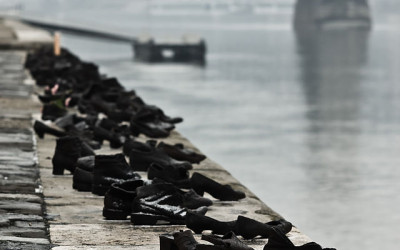
Monday’s Monument: Shoes on the Danube Promenade, Budapest, Hungary
Completed in April, 2005, this sculpture is a memorial created to honor the Jews who were murdered by fascist Arrow Cross Militiamen in Budapest in 1944-45, during World War II. The Brigade would line up as many Jews as possible and shoot them on the river’s bank to...
read more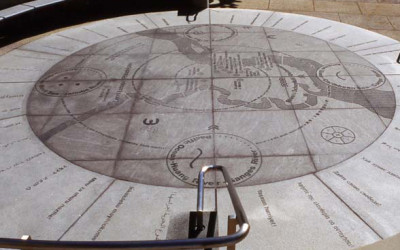
Monday’s Monument: The Freedom Ring, Philadelphia
Dedicated on the campus of the Community College of Philadelphia in 1994, The Freedom Ring celebrates the theme of freedom as it relates to peoples and cultures migrating across oceans in pursuit of refuge in Philadelphia. A “cosmogram” 24-feet in diameter, the...
read more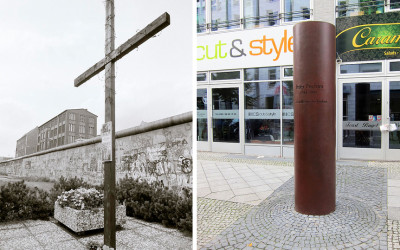
Monday’s Monument: Peter Fechter Memorial Obelisk, Berlin
Today is the anniversary of the 1962 murder of East German bricklayer Peter Fechter, who was shot crossing the Berlin Wall. A cross was quickly placed on the western side near the spot where Fechter was shot and slowly bled to death. At the invitation of Willy Brandt,...
read more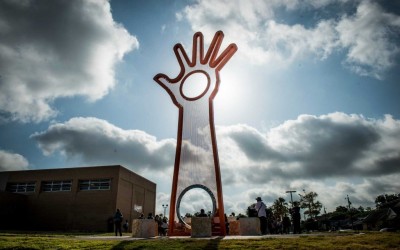
Monday’s Monument: Open Hand, Open Mind, Open Heart, San Antonio, TX
A new public artwork inspired by Dr. Martin Luther King Jr.’s message of non-violence was unveiled July 29th at Pittman-Sullivan Park on the city’s East Side.The 32-foot tall sculpture, entitled “Open Hand, Open Mind, Open Heart,” consists of perforated steel and...
read more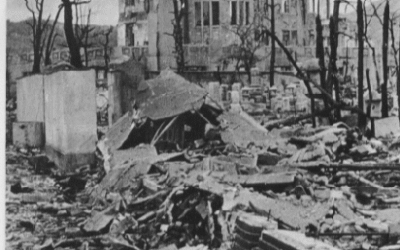
Monday’s Monument: Hiroshima Peace Memorial
Hiroshima Peace Memorial (広島平和記念碑 Hiroshima heiwa kinenhi), commonly called the Atomic Bomb Dome or Genbaku Dōmu (原爆ドーム, A-Bomb Dome), in Hiroshima, Japan, is part of the Hiroshima Peace Memorial Park and was designated a UNESCO World Heritage Site in 1996. The...
read more
If you
haven’t read
this book,
you should!
Ten Questions to Ask at a Historic Site
In his book Lies Across America, Professor James Loewen posed these ten questions to ask at a historic site.
1. When did this location become a historic site? (When was the marker or monument put up? Or the house interpreted?) How did that time differ from ours? From the time of the event or person interpreted?
2. Who sponsored it? representing which participant groups’s point of view? What was their position in the social structure when the event occurred? When the site went “up”?
3. What were the sponsor’s motives? What were their ideological needs and social purposes? What were their values?
4. What is the intended audience for the site? What values were they trying to leave for us, today? What does the site ask us to go and do or think about?
5. Did the sponsors have government support? At what level? Who was ruling the government at the time? What ideological arguments were used to get the government acquiescence?
6. Who is left out? What points of view go largely unheard? How would the story differ if a different group told it? Another political party? Race? Sex? Class? Religious group?
7. Are there problematic (insulting, degrading) words or symbols that would not be used today, or by other groups?
8. How is the site used today? Do traditional rituals continue to connect today’s public to it? Or is it ignored? Why?
9. Is the presentation accurate? What actually happened? What historical sources tell of the event, people, or period commemorated at this site?
10. How does the site fit in with others that treat the same era? Or subject? What other people lived ad events happened then but are not commemorated? Why?
Travel across the United States in a 1965 Airstream Trailer as filmmaker Tom Trinley visits historic sites and monuments unveiling the many sides of history not told on the landscape or in history books. On-camera appearances by Howard Zinn, James Loewen, Lonnie Bunch and Adam “Fortunate Eagle” Nordwall. Inspired by “Lies My Teacher Told Me” and “A Peoples’ History of the United States.”
At the Un-National Monument along the Canadian Border
By William E. Stafford
This is the field where the battle did not happen,
where the unknown soldier did not die.
This is the field where grass joined hands,
where no monument stands,
and the only heroic thing is the sky.
Birds fly here without any sound,
unfolding their wings across the open.
No people killed—or were killed—on this ground
hallowed by neglect and an air so tame
that people celebrate it by forgetting its name.
Of princes, shall outlive this powerful rhyme;
But you shall shine more bright in these contents
Than unswept stone besmear’d with sluttish time.
When wasteful war shall statues overturn,
And broils root out the work of masonry,
Nor Mars his sword nor war’s quick fire shall burn
The living record of your memory.
–William Shakespeare, from Sonnet 55

Listen to this song!
And we find it really hard to say we’re sorry
So the shadow of injustice still remains
We build monuments to those who died in battle
But we seldom speak of those who died in chains