
Request the Monuments Database
The weekly “Monday’s Monument” feature on this website is being fed from a database we are compiling that currently contains 200+ monuments. If you’d like a copy of the database, drop us a line.
Peace & Justice Monuments
Since May, 2015, every Monday morning the peaceCENTER has been posting a little essay about a peace or social justice monument. For more than a decade, ever since the peaceCENTER was contracted by a national peace & human rights group to develop a workshop exploring strategies for creating memorials about acts of violence and injustice that did not glorify the bloodshed, we have pondered the relationship between the landscape and civic memory.
“I would rather take care of the stomachs of the living than the glory of the departed in the form of monuments.”
Alfred Nobel
As we showcase these monuments we hope you will join us in this exploration. For now, we’re concentrating on publicly accessible outdoor works (indoor art, museums and historic sites may come later . . . ) Some are grassroots and homespun; others, more complicated in their funding and execution. They all have a story to tell and we can learn from all of them.
MONDAY’S MONUMENT
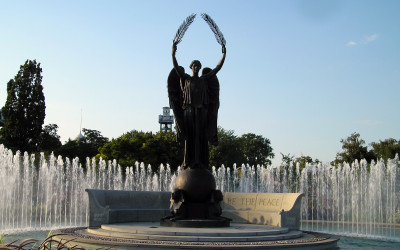
Monday’s Monument: Shrine Peace Memorial, Toronto
On 12 June 1930, this Peace Memorial was presented to the people of Canada by Imperial Potentate Noble Leo V. Youngworth, on behalf of the 600,000 members of the Ancient Arabic Order of Nobles of the Mystic Shrine (Masons) to commemorate the peaceful relationships...
read more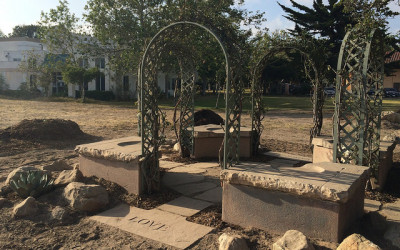
Monday’s Monument: Isla Vista, CA Perfect Park
The history of Isla Vista, adjacent to the University of California-Santa Barbara Campus, is complicated and volatile. In the Fall of 1969 a popular Anthropology professor was fired; early the next year there were massive protests; in February, the Bank of America...
read more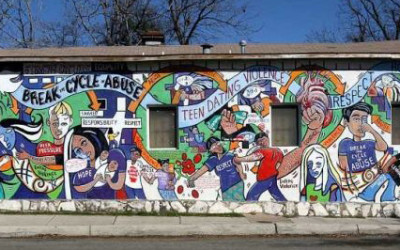
Monday’s Monument: Breaking the Cycle Mural, San Antonio, TX
Breaking the Cycle was the 18th mural installed by San Anto Cultural Arts, in 2002. It is by Mary Agnes Rodriguez, Ruth Buentello, Chris Munoz, & Daisy Tovar and is at 626 S Zarzamora in San Antonio. San Anto Cultural Arts fosters human and community development...
read more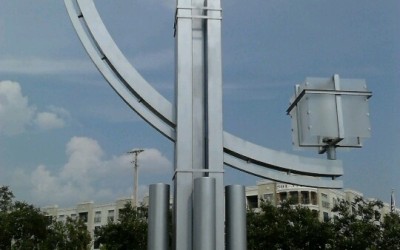
Monday’s Monument: Beacon for Peace & Hope, Little Rock
The Beacon of Peace and Hope is located in North Shore Riverwalk Park in North Little Rock, Arkansas. This beacon includes a peace garden along the walking trail. The garden is to provide a place for children and families a place to come together and celebrate peace...
read more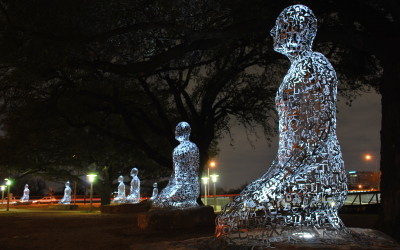
Monday’s Monument: Tolerance, Houston, TX
In February 2011 a group of seven 10-foot high installations called Tolerance was unveiled at Harmony Walk in Houston near the site of a planned Ismaili Center. Situated in an area designated as “Harmony Walk," the seven Tolerance figures, representing the seven...
read more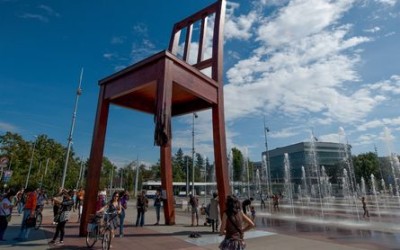
Monday’s Monument: Broken Chair, Palais des Nations, Geneva, Switzerland
‘Broken Chair’ is the work of sculptor Daniel Berset. It was made in 1997 for the NGO Handicap International. Its message is simple: remember the victims of landmines, urge your government to promote a ban on landmines and cluster bombs. To illustrate this combat, the...
read more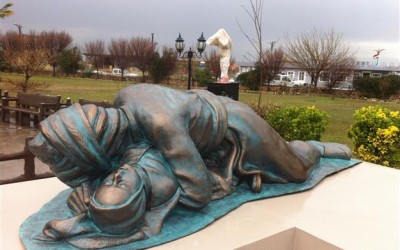
Monday’s Monument: Halabja Statue At The Hague, Netherlands
This memorial statue, dedicated to the victims of a March 13, 1988 chemical attack on the Iraqi Kurds of Halabja, was opened in the Hague in 2014, in the garden of the Organization for the Prohibition of Chemical Weapons (OPCW). The monument, inspired by a photograph...
read more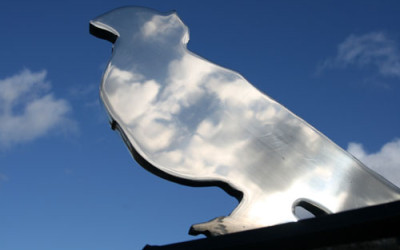
Monday’s Monument: Sheffield England Peace Doves
The stainless steel sculpture, by Richard Bartle, featuring seven life-size doves perched on the chimney of Browns Bar next to the Peace Gardens, was inspired by Pablo Picasso’s visit to the Second World Peace Congress held in the Sheffield, England in 1950. The...
read more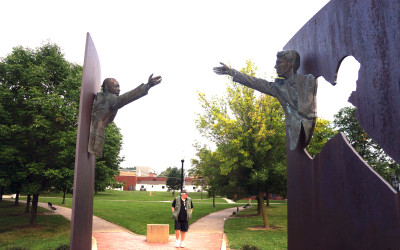
Monday’s Monument: Landmark for Peace, Indianapolis, Indiana
The Landmark for Peace is a memorial sculpture at Dr. Martin Luther King Jr. Park on the northside of Indianapolis that honors the contributions of the slain leaders Dr. Martin Luther King, Jr. and Robert F. Kennedy. On April 4, 1968, Robert Kennedy flew to...
read more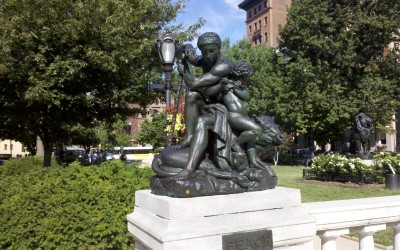
Monday’s Monument: Baltimore’s Peace Statue in Mount Vernon Place
Baltimore has been much on our minds lately. Just north of downtown is the Mount Vernon historical neighborhood, home to the Enoch Pratt Library, the Peabody Conservatory, the Walters Gallery and many other venerable Baltimore cultural institutions. It was named...
read more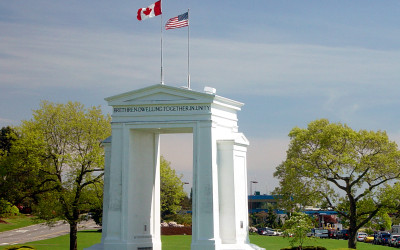
Monday’s Monument: Peace Arch Park
The Peace Arch is on the Canada–United States border between the Blaine, Washington and Surrey, British Columbia. It is 67 feet tall and dedicated in September 1921, commemorates the signing of the Treaty of Ghent in 1814. The monument is built on the exact United...
read more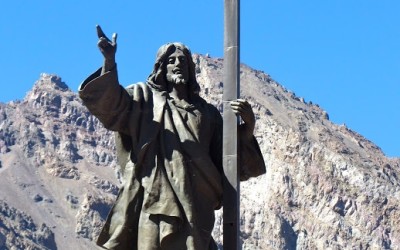
Monday’s Monument: Christ of the Andes
Lanza del Vasto wrote about this statue, officially called Christ, Redeemer of the Andes, in his book Warriors of Peace. When the relations between Argentina and Chile deteriorated, the two armies marched toward each other through the high passes in the Andes. But on...
read more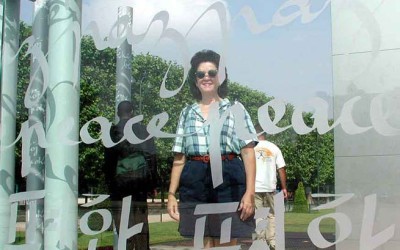
Monday’s Monument: Paris Wall of Peace
Starting today, the peaceCENTER's Web site will be featuring a peace monument every Monday. We'll continue doing this until we run out of monuments, which should be . . . never. Today we're looking at the Paris Wall for Peace (Mur de la Paix), installed in 2000;...
read more
If you
haven’t read
this book,
you should!
Ten Questions to Ask at a Historic Site
In his book Lies Across America, Professor James Loewen posed these ten questions to ask at a historic site.
1. When did this location become a historic site? (When was the marker or monument put up? Or the house interpreted?) How did that time differ from ours? From the time of the event or person interpreted?
2. Who sponsored it? representing which participant groups’s point of view? What was their position in the social structure when the event occurred? When the site went “up”?
3. What were the sponsor’s motives? What were their ideological needs and social purposes? What were their values?
4. What is the intended audience for the site? What values were they trying to leave for us, today? What does the site ask us to go and do or think about?
5. Did the sponsors have government support? At what level? Who was ruling the government at the time? What ideological arguments were used to get the government acquiescence?
6. Who is left out? What points of view go largely unheard? How would the story differ if a different group told it? Another political party? Race? Sex? Class? Religious group?
7. Are there problematic (insulting, degrading) words or symbols that would not be used today, or by other groups?
8. How is the site used today? Do traditional rituals continue to connect today’s public to it? Or is it ignored? Why?
9. Is the presentation accurate? What actually happened? What historical sources tell of the event, people, or period commemorated at this site?
10. How does the site fit in with others that treat the same era? Or subject? What other people lived ad events happened then but are not commemorated? Why?
Travel across the United States in a 1965 Airstream Trailer as filmmaker Tom Trinley visits historic sites and monuments unveiling the many sides of history not told on the landscape or in history books. On-camera appearances by Howard Zinn, James Loewen, Lonnie Bunch and Adam “Fortunate Eagle” Nordwall. Inspired by “Lies My Teacher Told Me” and “A Peoples’ History of the United States.”
At the Un-National Monument along the Canadian Border
By William E. Stafford
This is the field where the battle did not happen,
where the unknown soldier did not die.
This is the field where grass joined hands,
where no monument stands,
and the only heroic thing is the sky.
Birds fly here without any sound,
unfolding their wings across the open.
No people killed—or were killed—on this ground
hallowed by neglect and an air so tame
that people celebrate it by forgetting its name.
Of princes, shall outlive this powerful rhyme;
But you shall shine more bright in these contents
Than unswept stone besmear’d with sluttish time.
When wasteful war shall statues overturn,
And broils root out the work of masonry,
Nor Mars his sword nor war’s quick fire shall burn
The living record of your memory.
–William Shakespeare, from Sonnet 55

Listen to this song!
And we find it really hard to say we’re sorry
So the shadow of injustice still remains
We build monuments to those who died in battle
But we seldom speak of those who died in chains