
PEOPLE WITH A
PASSION FOR PEACE
Since 1995, the all-volunteer and interfaith peaceCENTER continues to be a significant community catalyst for peace in San Antonio, Texas. Compassion and Justice are our strong guiding lights. Contemplative Practices, Experiential Education, and Nonviolent Actions are our working expressions throughout the community at large.
285 Oblate Drive
San Antonio, Texas 78216
The peaceCENTER is a 501(c)((3)) non-profit

“It is easier to smash an atom than a prejudice. “
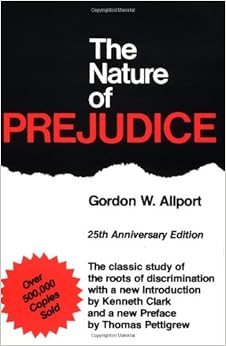
Confession time. I’ve been talking about Gordon Allport’s book The Nature of Prejudice (1954) as if I wrote the darn thing myself when, in truth, my exposure was probably a page or two in a social psychology textbook forty years ago. It seems like the right time to remedy that deficiency. The introduction is eloquent, enlightening, especially heartening in that Allport sees his work as practical as well as academic. It speaks for itself. More to come over the next few weeks . . . — Susan
 Introduction
Civilized men have gained notable mastery over energy, matter, and inanimate nature generally, and are rapidly learning to control physical suffering and premature death. But, by contrast, we appear to be living in the Stone Age so far as our handling of human relationships is concerned. Our deficit in social knowledge seems to void at every step our progress in physical knowledge. The surplus in wealth accumulating to the human race through applied natural science is virtually canceled by the costs of armaments and war. Gains in medical science are widely negated by the poverty that results from war and from trade barriers erected largely by hatred and fear.
At a time when the world as a whole suffers from panic induced by the rival ideologies of east and west, each corner of the earth has its own special burdens of animosity. Moslems distrust non‐ Moslems. Jews who escaped extermination in Central Europe find themselves in the new State of Israel surrounded by anti-Semitism. Refugees roam in inhospitable lands. Many of the colored people of the world suffer indignities at the hands of whites who invent a fanciful racist doctrine to justify their condescension. The checkerboard of prejudice in the United States is perhaps the most intricate of all. While some of this endless antagonism seems based upon a realistic conflict of interests, most of it, we suspect, is a product of the fears of the imagination. Yet imaginary fears can cause real suffering.
Rivalries and hatreds between groups are nothing new. What is new is the fact that technology has brought these groups too close together for comfort. Russia is no longer a distant land of the steppes; it is over here. The United States is no longer remote from the Old World; it is over there, with its Point IV, movies, Coca-Cola, and political influence. Nations once safely separated by barricades of water or mountains are exposed to each other by air. Radio, jets, television, paratroopers, international loans, post‐ war migrations, atomic blasts, moving pictures, tourism—all products of the modern age—have thrown human groups into each others’ laps. We have not yet learned how to adjust to our new mental and moral proximity.
Yet the situation is not without its hopeful features. Chief among these is the simple fact that human nature seems, on the whole, to prefer the sight of kindness and friendliness to the sight of cruelty. Normal men everywhere reject, in principle and by preference, the path of war and destruction. They like to live in peace and friendship with their neighbors; they prefer to love and be loved rather than to hate and be hated. Cruelty is not a favored human trait. Even the top Nazi officials who were tried at Nürnberg pretended that they knew nothing about the inhuman practices in the concentration camps. They shrank from admitting their part because they too wished to be thought of as human beings. While wars rage, yet our desire is for peace, and while animosity prevails, the weight of mankind’s approval is on the side of affiliation. So long as there is this sense of moral dilemma there is hope that it may somehow be resolved and that hate-free values may be brought to prevail. read more…
We are only maintaining the calendar at our Compassionate San Antonio site now.
2018 PEACE LAUREATES
