
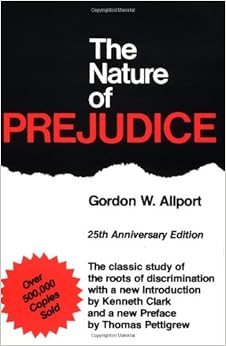
Confession time. I’ve been talking about Gordon Allport’s book The Nature of Prejudice (1954) as if I wrote the darn thing myself when, in truth, my exposure was probably a page or two in a social psychology textbook forty years ago. It seems like the right time to remedy that deficiency. The introduction is eloquent, enlightening, especially heartening in that Allport sees his work as practical as well as academic. It speaks for itself. More to come over the next few weeks . . . — Susan
 Introduction
Civilized men have gained notable mastery over energy, matter, and inanimate nature generally, and are rapidly learning to control physical suffering and premature death. But, by contrast, we appear to be living in the Stone Age so far as our handling of human relationships is concerned. Our deficit in social knowledge seems to void at every step our progress in physical knowledge. The surplus in wealth accumulating to the human race through applied natural science is virtually canceled by the costs of armaments and war. Gains in medical science are widely negated by the poverty that results from war and from trade barriers erected largely by hatred and fear.
At a time when the world as a whole suffers from panic induced by the rival ideologies of east and west, each corner of the earth has its own special burdens of animosity. Moslems distrust non‐ Moslems. Jews who escaped extermination in Central Europe find themselves in the new State of Israel surrounded by anti-Semitism. Refugees roam in inhospitable lands. Many of the colored people of the world suffer indignities at the hands of whites who invent a fanciful racist doctrine to justify their condescension. The checkerboard of prejudice in the United States is perhaps the most intricate of all. While some of this endless antagonism seems based upon a realistic conflict of interests, most of it, we suspect, is a product of the fears of the imagination. Yet imaginary fears can cause real suffering.
Rivalries and hatreds between groups are nothing new. What is new is the fact that technology has brought these groups too close together for comfort. Russia is no longer a distant land of the steppes; it is over here. The United States is no longer remote from the Old World; it is over there, with its Point IV, movies, Coca-Cola, and political influence. Nations once safely separated by barricades of water or mountains are exposed to each other by air. Radio, jets, television, paratroopers, international loans, post‐ war migrations, atomic blasts, moving pictures, tourism—all products of the modern age—have thrown human groups into each others’ laps. We have not yet learned how to adjust to our new mental and moral proximity.
Yet the situation is not without its hopeful features. Chief among these is the simple fact that human nature seems, on the whole, to prefer the sight of kindness and friendliness to the sight of cruelty. Normal men everywhere reject, in principle and by preference, the path of war and destruction. They like to live in peace and friendship with their neighbors; they prefer to love and be loved rather than to hate and be hated. Cruelty is not a favored human trait. Even the top Nazi officials who were tried at Nürnberg pretended that they knew nothing about the inhuman practices in the concentration camps. They shrank from admitting their part because they too wished to be thought of as human beings. While wars rage, yet our desire is for peace, and while animosity prevails, the weight of mankind’s approval is on the side of affiliation. So long as there is this sense of moral dilemma there is hope that it may somehow be resolved and that hate-free values may be brought to prevail.
Especially encouraging is the fact that in recent years men in large numbers have become convinced that scientific intelligence may help us solve the conflict. Theology has always viewed the clash between man’s destructive nature and his ideals as a matter of original sin resisting the redemptive process. Valid and expressive as this diagnosis may be, there has been added recently the conviction that man can and should employ his intelligence to assist in his redemption. Men are saying, “Let us make an objective study of conflict in culture and industry, between people of different color and race; let us seek out the roots of prejudice and find concrete means for implementing men’s affiliative values.” Since the end of the Second World War universities in many lands have given new prominence to this approach under various academic names: social science, human development, social psychology, human relations, social relations. Though not yet securely christened, the infant science is thriving. It has found considerable welcome not only in universities, but likewise in public schools, in churches, in progressive industries and government agencies, as well as in international bodies.
Within the past decade or two there has been more solid and enlightening study in this area than in all previous centuries combined. To be sure, the ethical guidelines for human conduct were stated millennia ago in the great creedal systems of mankind—all of them establishing the need and rationale for brotherhood among the earth’s inhabitants. But the creeds were formulated in the days of pastoral or nomadic living, in the time of shepherds and petty kingdoms. To implement them in a technical, atomic age requires an improved understanding of the factors making for hatred and tolerance. Science, it has been falsely assumed, should concern itself with material progress and leave human nature and social relationships to an unguided moral sense. We now know that technical advance by itself creates more problems than it solves.
Social science cannot catch up overnight, nor swiftly repair the ravages of undirected technology. It required years of labor and billions of dollars to gain the secret of the atom. It will take a still greater investment to gain the secrets of man’s irrational nature. It is easier, someone has said, to smash an atom than a prejudice. The subject of human relations is exceedingly broad. Work necessarily proceeds from a variety of starting points and is concerned with many areas of human association: family life, mental health, industrial relations, international negotiations, training for citizenship— to mention only a few.
The present volume does not pretend to deal with the science of human relations as a whole. It aims merely to clarify one underlying issue—the nature of human prejudice. But this issue is basic, for without knowledge of the roots of hostility we cannot hope to employ our intelligence effectively in controlling its destructiveness.
When we speak of prejudice we are likely to think of “race prejudice.” This is an unfortunate association of ideas, for throughout history human prejudice has had little to do with race. The conception of race is recent, scarcely a century old. For the most part prejudice and persecution have rested on other grounds, often on religion. Until the recent past Jews have been persecuted chiefly for their religion, not for their race. Negroes were enslaved primarily because they were economic assets, but the rationale took a religious form: they were pagans by nature, the presumed descendants of Noah’s son Ham, and cursed by Noah to be forever “the servants of servants.” The concept of race so popular today is in reality an anachronism. Even if it were once applicable, it is scarcely so any longer, owing to the endless dilution of human stocks through cross-mating.
Why then did the race concept become so popular? For one thing, religion lost much of its zeal for proselytizing and therewith its value for designating group membership. Moreover, the simplicity of “race” gave an immediate and visible mark, so it was thought, by which to designate victims of dislike. And the fiction of racial inferiority became, so it seemed, an irrefutable justification for prejudice. It had the stamp of biological finality, and spared people the pains of examining the complex economic, cultural, political, and psychological conditions that enter into group relations.
For most purposes the term “ethnic” is preferable to the term “race.” Ethnic refers to characteristics of groups that may be, in different proportions, physical, national, cultural, linguistic, reli
gious, or ideological in character. Unlike “race,” the term does not imply biological unity, a condition which in reality seldom marks the groups that are the targets of prejudice. It is true that “ethnic” does not easily cover occupational, class, caste, and political groupings, nor the two sexes—clusters that are also the victims of prejudice.
Unfortunately the lexicon of human groups is poor. Until social science offers an improved taxonomy we cannot speak with the precision we should like. It is possible, however, to avoid the error of referring to “race” when the term does not apply. It is, as Ashley‐ Montagu insists, a mischievous and retardative term in social science. We shall take pains to use it, when we do, in a properly limited manner. For groups marked by any form of cultural cohesion we shall employ “ethnic,” but at times may be guilty of overextending the meaning of this already broad term.
It is a serious error to ascribe prejudice and discrimination to any single taproot, reaching into economic exploitation, social structure, the mores, fear, aggression, sex conflict, or any other favored soil. Prejudice and discrimination, as we shall see, may draw nourishment from all these conditions, and many others.
While plural causation is the primary lesson we wish to teach, the reader may reasonably ask whether the author himself does not betray a psychological bias. Does he do justice to the complex economic, cultural, historical, and situational factors involved? Is he not, by professional habit, disposed to emphasize the role of learning, of cognitive processes, and of personality formation?
It is true that I believe it is only within the nexus of personality that we find the effective operation of historical, cultural, and economic factors. Unless mores somehow enter the fibre of individual lives they are not effective agents, for it is only individuals who can feel antagonism and practice discrimination. Yet “causation” is a broad term, and we can (and should) acknowledge long-range sociocultural etiology as well as the immediate causation that lies in attitudes held by the individual. I have tried (especially in Chapter 13) to present a balanced view of the several levels of causation, even though I place a heavy and convergent emphasis upon psychological factors. If, in spite of my efforts, the result still seems one-sided, I rely on critics to point out the failing.
While the researches and illustrations of this volume are drawn chiefly from the United States, I believe that our analysis of the dynamics of prejudice has universal validity. To be sure, the ways in which prejudice is manifested vary considerably from country to country: the selected victims are not the same; attitudes toward physical contact with disparaged groups differ; accusations an stereotypes vary. Yet such evidence as we have from other countries indicates that the basic causes and correlates are essentially identical. Gardner Murphy reaches this conclusion on the basis of his investigation of group tensions in India. His book In the Minds of Men is pertinent in this connection. Likewise, other studies conducted by agencies of the United Nations support this view. And anthropological literature, whether devoted to the practices of witchcraft, clan loyalty, or to warfare, suggests that while the targets of prejudice and its expression differ greatly, the underlying dynamics are much the same in all lands. While this guiding assumption seems safe, we should not yet regard it as conclusive. Future cross‐ cultural research will certainly show that the weighting and patterning of causal factors vary greatly in different regions, and that perhaps additional important causes must be added to our present account.
In writing this book I have had in mind two groups of readers, both of which I know to be deeply interested in its subject matter. One group comprises college and university students in all countries who are increasingly concerned with the social and psychological foundations of human behavior, seeking scientific guidance in the improvement of group relations. The second group consists of the growing population of older citizens and general readers who are of the same mind, although their interests on the whole may be less theoretical and more immediately practical. With these two groups in mind I have written my exposition in a fairly elementary fashion. Inevitably I have simplified some of the points at issue, but not, I hope, to a point that is in any respect scientifically misleading.
So great is the ferment of investigation and theory in this area that in one sense our account will soon be dated. New experiments will supersede old, and formulations of various theories will be improved. Yet there is one feature of the book that I believe will be of lasting value, namely, its principle of organization. I have tried to offer a framework into which future developments may readily fit.
While my purpose is primarily to clarify the field as a whole, I have also tried, especially in Part VIII, to show how our growing knowledge can be applied to the reduction of group tensions. A few years ago a census conducted by the American Council on Race Relations discovered 1350 organizations in the United States devoted explicitly to the improvement of group relations. With what degree of success they are operating is itself a problem requiring scientific evaluation, and is considered in some detail in Chapter 30. It is fallacious to take exclusively an academic point of view without checking what we say against practical action. At the same time it is wasteful for practical people to invest time and money in remedial programs that have little scientific support. The successful development of a science of human relations requires bridging basic research and active operation.

