
A young friend (thank you, Marc!) shared a puzzle on Facebook: Who Dies? Take a minute and think it through:

Many smart people have tried to solve the puzzle using advanced mathematics, physics, and simulation models. They all seem to agree that we don’t have enough information: just how heavy is that scooped-out ball at point E compared to the ball (or is it a wheel?) holding down the teeter-totter-of-death? Just how hard is Mr. E going to shove that ball? In the worst case scenario, everyone dies. In everyone’s solution, however, there are a few corpses. Someone dies.
My solution? No one dies. Mr. E doesn’t have to push the ball—in fact, how can we be sure that he intends to push? Maybe he’s selflessly running towards the ball to stop it from rolling down the ramp. Perhaps his goal is to kill the folks below, but could we talk some sense into him and have him step away from the edge? I bet we could. And how do we know that the other people lack the ability to move? Mr. D just needs to duck to get his head below the danger point (the gap looks wide enough.) Mr. C could roll to the right or left to get out from under those deadly spikes. It would just take a few seconds to depopulate that landscape so that no one dies.
The problem starts with the question: who dies? Haven’t you found that often the solution is shaped by the question? When we ask “who dies?” we focus on death, and someone always dies. Let’s illustrate that principle with a grammar question. Which is correct? (a) The yolk of an egg are white or (b) The yolk of an egg is white. Take a few seconds, think about it . . . most people (myself included) automatically choose (b) because it is, of course, grammatically correct. The right answer, though, is none of the above. The yolk of an egg is yellow. The context of the question (it’s a grammar question) and the multiple choice format (there is no (c) none of the above) lead us to a particular, wrong solution.
How could we frame the question to get a different response? We could start with an innocuous, broad question: “What is happening here?” That opens up the possibility that Mr. E is preparing to pull rather than push; that he is a savior rather than an assassin. It invites us to look closer. Can you think of questions that would produce different solutions?
Another factor that shapes the answer is the audience. This puzzle was posted to the usual gaggle of math and science nerds. There are other clues that indicate that this is a math problem: for example, the grid pattern superimposed on the landscape and the labeling of the people by letters instead of names. Those Science, Technology, Engineering and Math guys are going to come up with STEM solutions. You’ve probably heard the phrase, “If all you have is a hammer, everything looks like a nail.” A recent New Yorker Cartoon added a clever twist to this:
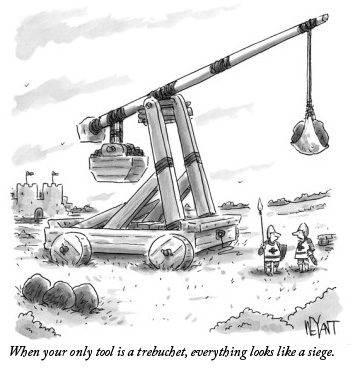
So, who else should be invited into the question? Would we get a different answers if we asked social workers, poets, or people of faith? It goes the other way, too: if all the people puzzling over the answer are poets, maybe we need to add a mathematician to the mix. Here’s another take on the same issue:
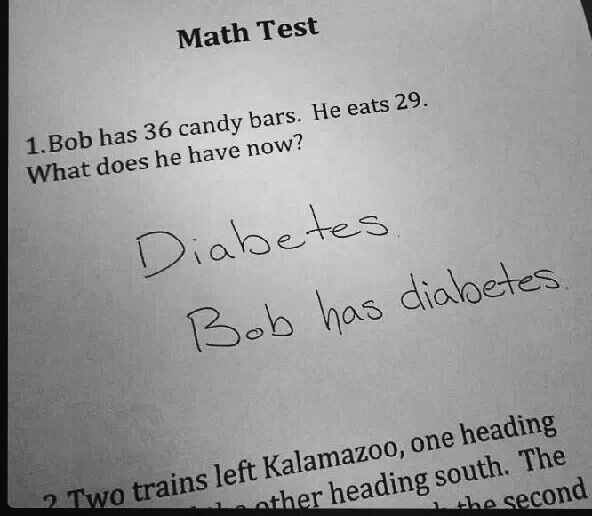
The playwright George Bernard Shaw famously said, “Some look at things that are, and ask why. I dream of things that never were and ask why not? It’s all about the question. Pay attention to the questions and ask, “why not . . . ?”

