
“Third Reading,” is a reflection on the gospel, interpreted with an emphasis on Peace & Justice. This entry is for the Sixteenth Sunday in Ordinary Time, as it is called in the Catholic liturgy. This new weekly feature is brought to us by the San Antonio Chapter of Pax Christi, a Christian lay organization dedicated to preventing a repetition of the savagery of the twentieth century’s world wars.
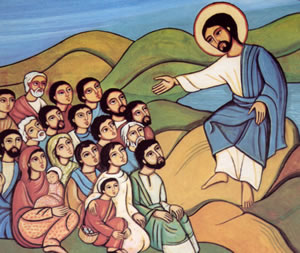 “And disembarking he saw a great crowd, and he felt sorry for them because they were like sheep having no shepherd, and he began to teach them many things.”
The stress is not on what Jesus was teaching the crowd or how he was doing it, but why. He felt sorry for them; he saw a need. They were like sheep having no shepherd; they were like sheep that were unable to find their own way to places where they could thrive.
Mark will go on to a highly symbolic miracle narrative, that of the multiplication of the loaves of bread and the fishes. But first he makes it clear that it was the poor distribution of consciousness that drew Jesus’ attention. So Jesus began to teach the crowd many things. Here it was not to his selected insiders or to a dinner of dignitaries that he spoke, but a crowd of ordinary people, who were curious enough to hike around the lake to see and hear him but who were not distinguished by anything special enough to have been remembered and written down by the evangelist.
Ordinary people tend to be pragmatic in many respects. In contrast it is usually those who have the leisure to indoctrinate themselves who follow elaborate ideologies. We can understand why some who are privileged have prejudices against the non-privileged; they sense a need to make their privilege seem merited and reasonable, and they can use their leisure to elaborate ideologies to serve such a purpose. But why are some who are non-privileged and ordinary have prejudices against one another? And in our democratic era, why do some non-privileged join political movements that favor those who need no further favors, and usually at the expense of the non-privileged themselves?
It may be said of our time that masses of the many seek to be counted among the number of the few—the arithmetically impossible “wannabe” phenomenon. But that was not the case in first century Galilee. What one was born as, one would remain, and everyone knew it. There were only the received formulae of everyday life, conventions, traditions. And when some new problem arose—and one always does—these ordinary people were like sheep without a shepherd. Are we any better off? Does our world suffer from a poor distribution of consciousness? © 2015 Anthony J. Blasi

