
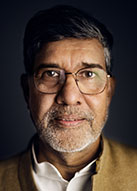

The 2014 Nobel Peace Prize was awarded to Kailash Satyarthi, of India and to Malala Yousafzai, of Pakistan, for their struggle against the suppression of children and young people and for the right of all children to education. In her Nobel lecture Malala said, “I had two options. One was to remain silent and wait to be killed. And the second was to speak up and then be killed. I chose the second one. I decided to speak up.” Kailash Satyarthi said, “I remember an eight-year-old girl we rescued from intergenerational forced labour from stone quarries. When she was sitting in my car right after her rescue, she asked me: ‘Why did you not come earlier?’ Her angry question still shakes me – and has the power to shake the whole world. Her question is for all of us. What are we doing? What are we waiting for? How many girls will we allow to go without rescue?”
The Nobel Peace Prize is one of the five Nobel Prizes created by the Swedish industrialist, inventor, and armaments manufacturer Alfred Nobel. Since 1901 it has been awarded annually (with some exceptions) to those who have “done the most or the best work for fraternity between nations, for the abolition or reduction of standing armies and for the holding and promotion of peace congresses” Over the next few months we’ll be introducing you to the past Nobel laureates, leading up to the award of the 2016 prize in October.

